Guide · Generators
What Size Portable Generator Do I Need?
Estimate the running and starting watts for the appliances and equipment you actually need to use, then compare generators with enough continuous output and surge capacity.
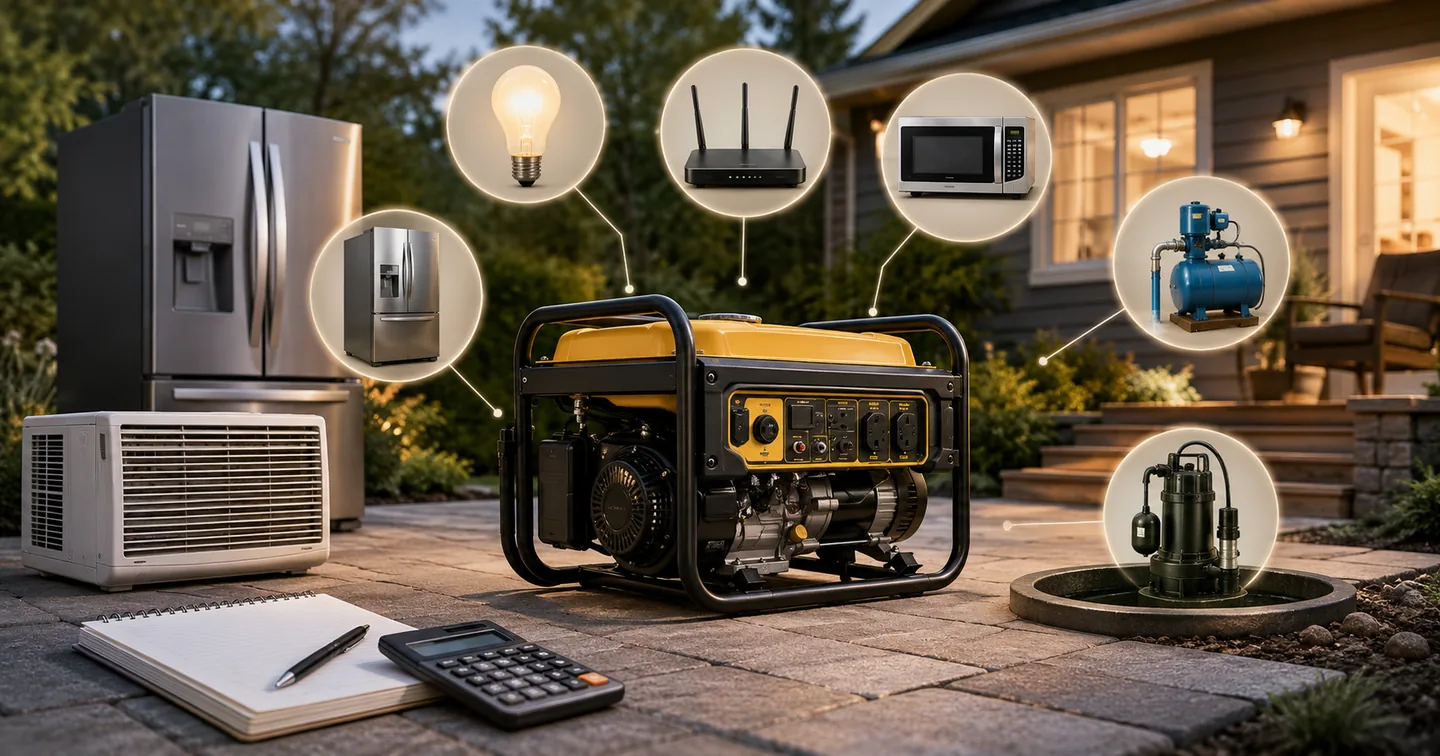
Buying a portable generator isn’t really about buying the biggest machine you can afford.
It’s about figuring out what you actually need to keep running when the power goes out.
A refrigerator and Wi-Fi router don’t need much.
Add a well pump, furnace blower, sump pump, microwave, and window air conditioner and suddenly you’re shopping in a completely different generator class.
That’s why I’d start with the loads—not the generator.
The calculator below gives you a reasonable planning estimate using typical appliance wattages. If you have the actual wattage from an appliance label, manual, or manufacturer specification, use that instead.
Portable Generator Wattage Calculator
Planning tool
Build your simultaneous load
Choose the equipment you expect to run at the same time. Know the actual wattage? Replace our estimate with the value from your appliance label or manual.
One or more selected loads may require 240V or may be permanently wired. A generator can have enough total wattage and still be incompatible with the equipment you want to power. Check the appliance/pump specifications and generator output.
Furnaces, well pumps, and other permanent household circuits generally require appropriate generator inlet/transfer equipment. Do not connect a portable generator to household wiring by backfeeding through a dryer, range, or ordinary receptacle. Read Beware of Backfeeding before planning a house connection.
You can reduce simultaneous running wattage by not operating temporary high-wattage loads at the same time. Microwave, toaster, hair dryer, space heater, and coffee maker loads are often easier to manage than continuous essentials.
This assumes large motor loads do not all start simultaneously. Actual peak demand can be higher.
I would leave some headroom rather than buying a generator that exactly matches these numbers. Generic appliance estimates, changing loads, and motor startup behavior make exact-fit sizing unnecessarily tight.
Running Watts vs. Starting Watts
This is the part that confuses people.
Suppose your refrigerator needs about 300 watts while it’s running.
When the compressor starts, it may briefly need substantially more power.
The same thing happens with:
- pumps
- air conditioners
- compressors
- furnace blowers
- some refrigerators and freezers
That extra demand only lasts briefly, but your generator still needs to handle it. For additional planning examples, see the Champion Generator Wattage Chart and Honda’s generator wattage estimation guide.
How the Calculator Does the Math
Let’s say you’re running:
- Refrigerator: 300W
- Freezer: 300W
- Furnace blower: 800W
- Wi-Fi: 20W
- Six LED lights: 60W
Your continuous load is:
1,480 running watts
Now suppose the refrigerator has the largest additional startup demand at about 900 watts.
Your estimated peak becomes:
1,480 + 900 = 2,380 watts
You do not normally add every appliance’s full startup surge together.
The usual planning assumption is that you’re covering the largest motor startup on top of the normal running load.
That does assume several large motors aren’t trying to start at exactly the same moment, which is another reason this calculator should be treated as a planning tool rather than an electrical design.
Don’t Buy a Generator With Exactly Enough Power
If my calculation said I needed 2,380 peak watts, I wouldn’t go looking for a generator rated at exactly 2,400 peak watts.
I’d want some room.
Loads change.
Compressors cycle.
Someone plugs something in.
Actual appliance wattage isn’t necessarily identical to a generic calculator estimate.
You also don’t gain anything by making the generator operate right at its limit all the time.
So use the calculator to identify the class of generator you need rather than treating the result like a precision engineering number.
Basic Outage Example
Let’s say I want to keep these running:
- refrigerator
- deep freezer
- Wi-Fi
- television
- six LED lights
Using our planning values:
Running load: about 830 watts
Add roughly 900 watts for the largest startup surge:
Estimated peak: about 1,730 watts
That’s a pretty modest electrical load.
It shows why someone who only wants refrigeration, lights, internet, and a few electronics may not need a giant generator.
Winter Outage Example
Now let’s make things more interesting:
- refrigerator
- deep freezer
- gas furnace blower
- 1/3-HP sump pump
- Wi-Fi
- six LED lights
Estimated running load:
About 2,280 watts
Largest additional startup requirement:
About 900 watts
Estimated peak:
About 3,180 watts
Now we’re moving into a meaningfully larger generator.
And remember: the furnace and sump pump may be permanently wired equipment. Having enough watts does not mean you can simply plug them into the generator with an extension cord.
How the generator connects to the house matters too.
Summer Outage Example
Suppose you want:
- refrigerator
- deep freezer
- 10,000 BTU window AC
- Wi-Fi
- six LED lights
Estimated running load:
About 1,880 watts
Estimated peak after the air conditioner starts:
About 3,080 watts
The interesting thing here is that the window air conditioner doesn’t add an enormous continuous load.
The startup surge is what changes the generator requirement.
A Well Pump Changes Things Quickly
Now consider:
- refrigerator
- 1 HP well pump
- gas furnace blower
- Wi-Fi
- six LED lights
Estimated running load:
About 2,680 watts
But our planning estimate for the well pump adds another:
2,500 watts of startup demand
That puts the estimated peak around:
5,180 watts
And there’s another problem:
Voltage.
Many well pumps use 240 volts.
A generator can have enough total watts and still be completely wrong for the job if it doesn’t provide the voltage your equipment requires.
This is why I would take well pumps seriously when sizing a backup generator.
Check the actual pump specifications.
Watts Aren’t the Only Thing That Matters
This is probably the most important limitation of any online generator calculator.
A result saying:
You need 5,000 watts.
doesn’t necessarily mean every 5,000-watt generator will work.
You also need to think about:
- 120V vs. 240V
- receptacles
- generator inlet configuration
- transfer equipment
- startup capacity
- how loads will be managed
If you’re trying to power hardwired equipment such as a furnace, well pump, or household circuits, the electrical connection needs to be part of the plan. Read Beware of Backfeeding before planning a house connection.
Don’t backfeed the house through a dryer outlet or another receptacle.
Use proper transfer equipment installed for the electrical system.
Some Appliances Are Generator Hogs
There are a few appliances I’d think twice about during an outage.
Space Heaters
A typical electric space heater can consume around 1,500 watts continuously.
That’s an enormous amount of generator capacity for something producing heat.
If you’re trying to run a refrigerator, freezer, sump pump, furnace blower, and other essentials, adding a 1,500-watt resistance heater can make a surprisingly large difference.
Hair Dryers
Same problem.
A hair dryer may consume around 1,500 watts.
That doesn’t mean you can’t use one.
It means I probably wouldn’t size the entire generator around the assumption that the hair dryer, microwave, furnace, pumps, and everything else need to run simultaneously.
Electric Cooking
Electric cooking uses a lot of power too.
A single range element can consume a couple thousand watts.
A complete electric range is a completely different load and may exceed what makes sense for a normal portable-generator setup.
During an outage, load management can make a much smaller generator work.
Load Management Can Save You a Lot of Generator
This is one of the most practical things to understand.
You don’t necessarily need enough power to run every electrical device in your house simultaneously.
Maybe you:
- keep the refrigerator and freezer running normally
- run the well pump when necessary
- turn off a large temporary load before using the microwave
- don’t run the hair dryer and space heater at the same time
That can be the difference between needing a moderate generator and buying a much larger, heavier, thirstier machine.
For most portable-generator users, I’d rather think about what needs to run continuously and what can be used temporarily.
Generator Running Watts vs. Starting Watts
Generators themselves are usually advertised with two numbers too.
For example, you might see something marketed as:
6,500 starting watts / 5,000 running watts
The 6,500 number is not what the generator can necessarily supply continuously.
That’s its short-duration surge capability.
The 5,000-watt rating is the more important number when you’re adding up continuous loads.
So if your calculator says:
4,500 running watts
you need a generator whose running/rated output can handle that—not one that merely advertises 4,500 starting watts.
Then make sure the generator’s surge rating can also cover your estimated startup peak.
120V vs. 240V Matters
I would show a warning in the calculator whenever someone selects a load that commonly may require 240V.
Potential examples include:
- well pumps
- some sump pumps
- some furnace equipment
- electric range elements
- larger household equipment
The exact voltage needs to come from the equipment.
Don’t assume.
This is another reason a calculator can’t replace checking your actual appliances.
What About a CPAP?
A CPAP generally uses relatively little power compared with heating equipment or large appliances, although a heated humidifier can increase consumption.
But if you’re relying on one as a medical device, don’t size your emergency-power plan solely around a generic number from this calculator.
Use the specifications from your exact CPAP manufacturer and have a backup plan appropriate for your medical needs.
What Size Generator Would I Start Looking At?
I think of portable generators in broad groups rather than pretending there’s one perfect wattage.
Around 2,000–3,000 Running Watts
Potentially enough for a modest group of essentials:
- refrigeration
- lights
- internet
- electronics
- some carefully managed temporary loads
Around 3,500–5,000 Running Watts
This starts giving you more room for things like:
- furnace blower
- sump pump
- window air conditioner
- refrigeration
- selected kitchen appliances
depending on startup requirements.
Around 5,000–7,500 Running Watts
Now you can start supporting a more substantial home-backup plan, potentially including pumps and several simultaneous essentials.
At this point I’d pay particularly close attention to 240V requirements and how the generator connects to the house.
Above That
You may legitimately need more power.
But I’d stop and ask whether the goal is still portable emergency power or whether you’re moving toward something closer to whole-home backup.
A larger generator burns more fuel, costs more, weighs more, and is harder to move. Make sure the fuel-storage side is part of the plan too; read How to Safely Store Gasoline for a Portable Generator.
I’d rather understand the loads first than automatically buy the biggest generator on the shelf.
Recreational Generator Sizing
The same math applies outside the house.
An RV air conditioner is often the big startup load.
Then you may also have:
- refrigerator
- microwave
- coffee maker
- television
- CPAP
- chargers
- lights
Again, the question isn’t how many things are in the RV.
It’s which ones are operating at the same time.
Jobsite Generator Sizing
Jobsite equipment can have very large startup loads.
Motors in:
- circular saws
- table saws
- air compressors
- pumps
may require considerably more power to start than they use once running.
That’s another situation where I’d put the actual tool specifications into the calculator rather than relying entirely on generic presets.
The Best Number Is on the Appliance
The calculator is there to get you close.
But if you’re seriously planning a backup-power system, walk around the house and look at the equipment.
You may find wattage directly on the label.
If you only see volts and amps, power can often be estimated with:
Volts × Amps = Watts
For equipment with motors, compressors, complex electronics, or unusual startup requirements, use the manufacturer’s actual specification rather than assuming that simple multiplication captures everything.
My Approach
I wouldn’t start generator shopping by saying:
I think a 5,000-watt generator sounds about right.
I’d make a list.
I’d decide what actually needs to stay on.
I’d identify the big motor loads.
I’d check which things require 240V.
Then I’d calculate the running load and the largest startup surge.
Only after that would I start comparing generators. For the broader ownership questions, see our guides to gas vs. propane vs. dual-fuel generators, solar generators vs. gas generators, generator oil changes, and what to check when a generator won’t start.
Sizing isn’t the most exciting part of buying a portable generator.
It’s probably the part that matters most.
A generator that’s too small is frustrating.
A generator that’s dramatically oversized costs more, burns more fuel, and is harder to move around.
The right one is simply big enough to comfortably run the things you actually care about when the power goes out.
Related guides
guide · Generators
Beware of Backfeeding
guide · Generators
How to Safely Store Gasoline for a Portable Generator
guide · Generators
How Often Should You Change Generator Oil?
guide · Generators
Generator Won't Start? Check These Things First
comparison · Generators
Gas vs. Propane vs. Dual-Fuel Generators
comparison · Generators