Guide · Generators
How to Safely Store Gasoline for a Portable Generator
Emergency generator fuel should be based on what your generator actually uses and what you can safely and legally store—not an arbitrary stockpile number.
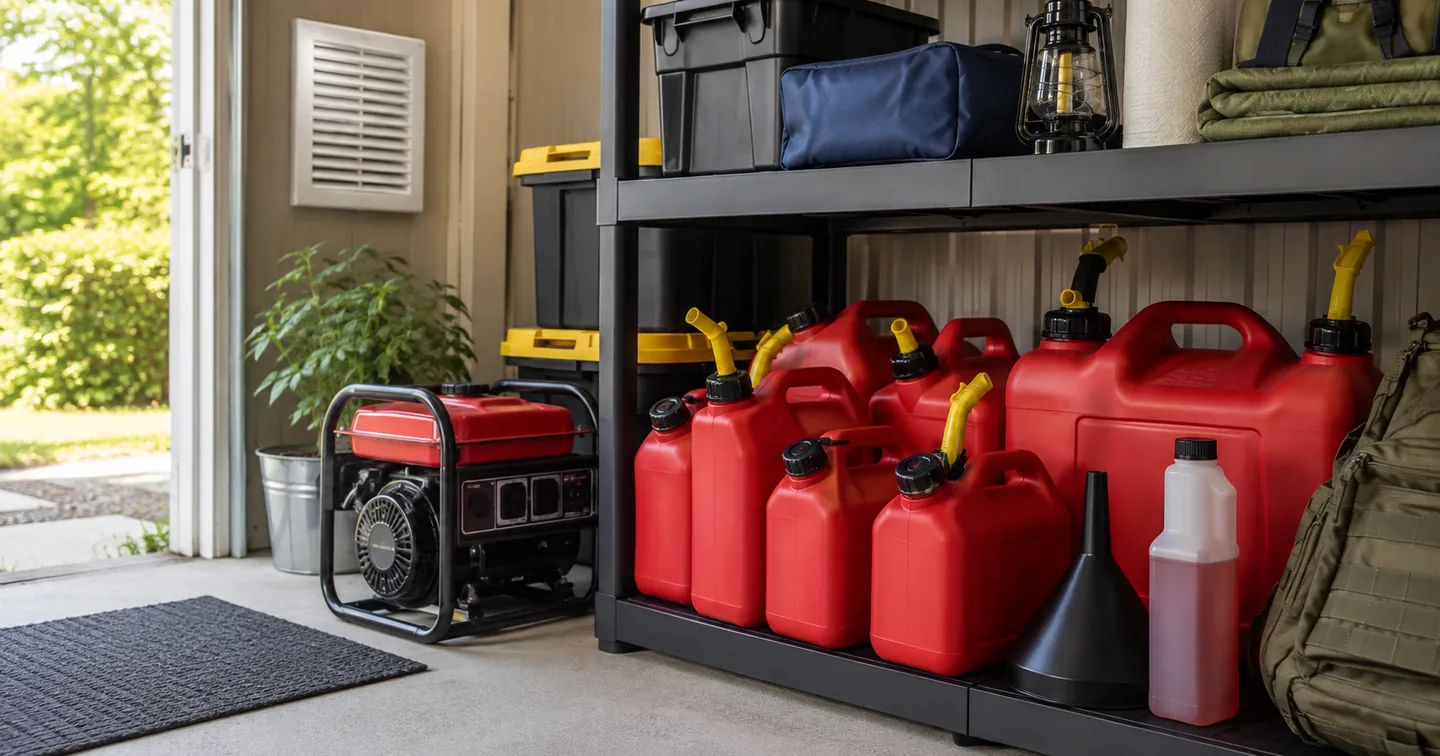
A portable generator isn’t much help during a power outage if you don’t have fuel for it.
That’s why keeping some emergency gasoline on hand can make sense.
What I wouldn’t do is pick an arbitrary number like 25 or 30 gallons and decide that’s what every homeowner should stockpile.
Gasoline is extremely flammable, storage rules vary by location, and generators can burn very different amounts of fuel depending on their size and load.
I’d approach it the other way around:
Figure out how much fuel your generator actually uses, decide how long you realistically want to run it, and then determine how much gasoline you can safely and legally store at your property.
For some homeowners, that may only be a few gallons.
For others preparing for longer outages, the number may be higher.
But this is one situation where more isn’t automatically better.
The Short Answer
If you’re keeping gasoline for emergency generator use:
- use containers specifically designed for gasoline
- keep the containers tightly closed
- store them in a cool, well-ventilated location away from the living space and ignition sources
- keep them secured away from children
- follow local fire-code limits on how much gasoline you can store
- rotate the fuel rather than forgetting about it for years
- use fuel stabilizer only according to the product and equipment manufacturer’s instructions
- never refuel a running or hot generator
And don’t assume that leaving your generator completely full of gasoline for the next year is automatically the best storage strategy.
Generator manufacturers have different recommendations for long-term storage.
Check the manual for your machine.
How Much Gasoline Does Your Generator Actually Need?
Before buying a bunch of gas cans, figure out what the generator burns.
The owner’s manual or manufacturer specifications may give fuel-consumption estimates at different loads.
If your generator uses roughly a certain number of gallons per hour at the load you expect to run, you can make a rough outage plan from there.
For example:
Fuel consumption per hour × planned generator runtime = approximate fuel requirement
But be realistic about the runtime.
A generator doesn’t necessarily need to run 24 hours a day during an outage.
You might decide that you mainly need it to:
- keep the refrigerator and freezer cold
- run a well pump periodically
- keep essential lights and electronics available
- run heating equipment where the generator and electrical setup support it
That could result in a very different fuel requirement than someone trying to keep most of the house powered continuously.
I’d work backward from the things I actually need to power instead of simply buying as much gasoline as I can store. Our portable generator wattage calculator can help define those loads.
Don’t Assume You Should Store 25 or 30 Gallons
You’ll find emergency-preparedness advice online that recommends keeping fairly large amounts of gasoline at home.
I don’t think that’s a good universal recommendation.
Residential gasoline-storage limits can depend on:
- local fire code
- container type
- where the fuel is stored
- whether the garage is attached or detached
- local building requirements
- insurance requirements
Gasoline vapors are flammable too, which is why storage location matters as much as the container itself.
Before building a large gasoline reserve, check the rules where you live.
Your local fire department or fire marshal is a much better source for the allowable quantity at your property than a generic number from a generator website.
Use Real Gasoline Containers
Don’t store gasoline in whatever container happens to be available.
Use a current portable fuel container specifically designed for gasoline.
Modern portable fuel containers sold in the United States are subject to safety requirements intended to reduce hazards such as flame traveling back into the container.
That’s a meaningful improvement over an old mystery gas can that’s been sitting in the corner of a shed for 20 years.
I’d retire containers that are:
- cracked
- badly faded or brittle
- leaking
- missing working caps or closures
- heavily damaged
- not actually designed for gasoline
And definitely don’t put gasoline into:
- water bottles
- milk jugs
- buckets
- food containers
- random plastic containers
Use the equipment intended for the job.
Recommended options
A Current Gas Can I'd Consider
Scepter 5-Gallon SmartControl Gasoline Can (FSCG552)
Scepter
Accessory
If an old or damaged gasoline container needs replacing, this is a current five-gallon option I would consider. A new can does not make a large fuel supply automatically safe or legal; the storage location, local rules, and fuel rotation plan still matter.
Check current price at AmazonWhere Should You Store Gasoline?
This matters.
CPSC fuel-container safety guidance says to keep gasoline out of houses and basements, in a cool, well-ventilated area away from ignition sources.
I’d also keep it far away from anything that can ignite gasoline vapors.
That includes things like:
- open flames
- pilot lights
- heaters
- furnaces
- sparks
- hot equipment
- other ignition sources
A cool, well-ventilated storage area away from the living space is the direction I’d look.
For a homeowner with a detached shed or other appropriate outbuilding, that may be a much more logical place than somewhere inside the house.
But don’t assume a particular shed, garage, cabinet, or storage arrangement automatically complies with local fire code.
This is especially worth checking if you plan to keep more than a couple of ordinary gas cans.
Don’t Store Gasoline Next to the Generator
This seems convenient.
It’s also not how I’d arrange things.
Generators get hot.
They have electrical components.
Their engines and exhaust systems can create ignition hazards.
CPSC specifically advises keeping fuel containers away from devices that can create sparks or ignite fuel vapors.
Your emergency fuel supply and your generator do not need to share the same little corner.
Keep Containers Closed
Gasoline containers should remain closed when you’re not actively filling or dispensing fuel.
Don’t intentionally leave the cap loose to “let the fumes out.”
And I would absolutely remove the old advice you sometimes see telling homeowners to periodically open a swollen or pressurized gasoline container to release vapor.
If a fuel container is behaving abnormally, damaged, leaking, or visibly distorted, don’t casually open it to relieve pressure.
Follow the container manufacturer’s instructions and keep people and ignition sources away from the problem.
A damaged gasoline container is not something I’d troubleshoot by improvising.
Fill Gas Cans on the Ground
When filling a portable gasoline container at a gas station, put the container on the ground.
Don’t leave it sitting in:
- the trunk
- the back of an SUV
- a truck bed with a liner
while you’re filling it.
Follow the instructions on the container and at the fuel pump.
Replace the cap securely when you’re done.
This is one of those small habits that’s easy to get right every time.
What About Fuel Stabilizer?
Fuel stabilizer can be useful for gasoline that won’t be used immediately.
What I wouldn’t do is tell everyone:
Add exactly two ounces per five gallons and the fuel will be good for a year.
Different stabilizers have different concentrations and storage claims.
Different engine manufacturers also give different fuel-storage recommendations.
So follow:
- the instructions for the stabilizer you’re actually using, and
- the storage guidance for your generator.
Don’t double the dosage because an old article says that automatically doubles the storage life.
If a manufacturer says its product can preserve fuel for a particular period, follow that manufacturer’s directions.
Recommended options
One Fuel Stabilizer Option
STA-BIL Storage Fuel Stabilizer
STA-BIL
Accessory
STA-BIL Storage is one example of a fuel stabilizer intended for gasoline being stored rather than immediately consumed. Follow the dosage and storage instructions on the actual product and the generator's storage instructions; stabilizer does not make gasoline permanent.
Check current price at AmazonGasoline Doesn’t Stay Fresh Forever
Even treated gasoline isn’t something I’d put in the shed and forget about indefinitely.
Fuel degrades over time.
That can become a real problem in a small engine because stale fuel and deposits can make a generator difficult—or impossible—to start.
Which is particularly unfortunate because the whole reason you own the generator is to have something reliable when everything else has gone wrong.
I’d rotate stored gasoline as part of normal maintenance.
Instead of waiting until emergency fuel gets old enough that you’re wondering whether it’s still usable, cycle it through equipment or a vehicle where appropriate and replenish your emergency supply with fresh fuel.
How often you need to do that depends on the fuel, storage conditions, stabilizer, and manufacturer guidance.
The key is to have a rotation plan.
Should You Leave Gasoline in the Generator?
This is one of those questions where the manual matters more than generic advice.
Some generator manufacturers recommend stabilized fuel for certain storage periods.
Others recommend draining the tank and fuel system once the generator will be stored beyond a certain amount of time.
There can also be separate instructions for getting fuel out of the carburetor.
For example, Generac recommends draining the fuel and running the carburetor dry for many portable generators if they’re going to be stored for more than about 30 days.
Champion has models where properly stabilized gasoline may remain in the tank for longer storage periods, while still requiring specific steps for the carburetor and fuel system.
That’s exactly why I wouldn’t make a universal rule that says:
Always keep the generator full.
or:
Always drain the generator.
Look up the storage section of the manual for your exact machine.
The Carburetor Is Often Where Old Fuel Causes Trouble
Leaving old gasoline in a small-engine carburetor can cause deposits that interfere with fuel flow.
That’s one of the classic reasons a generator that ran perfectly last year suddenly refuses to cooperate during the next outage.
If your manufacturer tells you to:
- close the fuel valve
- run the carburetor dry
- drain the carburetor
- use stabilized fuel
follow that procedure.
Don’t assume the storage procedure from somebody else’s generator applies to yours.
If stale fuel is keeping the generator from starting, work through the basic checks in Generator Won’t Start?.
Safely Refueling a Portable Generator
This part is simple enough that I wouldn’t compromise on it.
Never refuel a generator while it’s running.
Shut it down.
Let it cool.
Then refuel it according to the manufacturer’s instructions.
A generator that has been working hard for hours can have extremely hot engine and exhaust components.
Spilling gasoline onto them can start a fire.
CPSC generator safety guidance specifically tells consumers to shut generators down and allow them to cool before refueling.
That’s worth waiting for.
Never Run the Generator Where You Store the Gas
There’s another reason to separate generator operation from fuel storage:
A portable generator should be operating outside and well away from the home.
It should never be running inside:
- a house
- garage
- basement
- shed
- enclosed porch
- other enclosed or partially enclosed area
Portable generators produce carbon monoxide.
CPSC currently recommends operating them outside at least 20 feet from the home, with the exhaust pointed away from the house and nearby buildings.
So the shed where you store equipment is not automatically the place where the generator should run.
Storage and operation are two different problems.
Don’t Refuel in the Middle of a Rush
Power outages make people do strange things.
It’s dark.
The refrigerator has been off.
The kids are asking when the lights will come back.
The generator is getting low.
That’s exactly when I wouldn’t rush through refueling.
Shut everything down properly and give the machine time to cool.
I’d rather lose power for a little while than spill gasoline onto a hot muffler because I was trying to save five minutes.
Plan for Fuel Before Storm Season
The easiest generator fuel plan is the one you work out before anyone is talking about an incoming storm.
Before outage season, I’d know:
- how much fuel my generator uses
- which loads I actually plan to power
- approximately how many hours per day I expect to run it
- how much gasoline I can safely and legally store
- where that gasoline will be stored
- how I’m rotating the fuel
- what the generator manufacturer recommends for long-term storage
I’d also make sure my gas cans are in good condition.
Waiting until every other person in town is filling gas cans isn’t the time to discover yours leaks.
More Fuel Isn’t Always Better
The old way of thinking about emergency gasoline was often:
If five gallons is good, 30 gallons must be better.
I don’t think that’s the right way to approach it.
Gasoline gives you energy security during an outage.
It also introduces a highly flammable liquid onto your property.
The goal should be to keep enough emergency fuel—not as much as possible.
Figure out what your generator actually consumes.
Have a realistic outage plan.
Check your local storage rules.
Use proper containers.
Rotate the fuel.
And keep the whole system simple enough that you’ll actually maintain it.
That’s a much better emergency plan than finding a forgotten stack of old gas cans in the shed when the lights go out.
For related planning, see How Often Should You Change Generator Oil?, Beware of Backfeeding, and the tradeoffs in gas vs. propane vs. dual-fuel generators or solar generators vs. gas generators.
Related guides
guide · Generators
What Size Portable Generator Do I Need?
guide · Generators
How Often Should You Change Generator Oil?
guide · Generators
Generator Won't Start? Check These Things First
guide · Generators
Beware of Backfeeding
comparison · Generators
Gas vs. Propane vs. Dual-Fuel Generators
comparison · Generators