Guide · Generators
Generator Won't Start? Check These Things First
Before assuming the generator is broken, start with the boring checks: fuel, oil, controls, choke, air, ignition, and what happened while it was in storage.
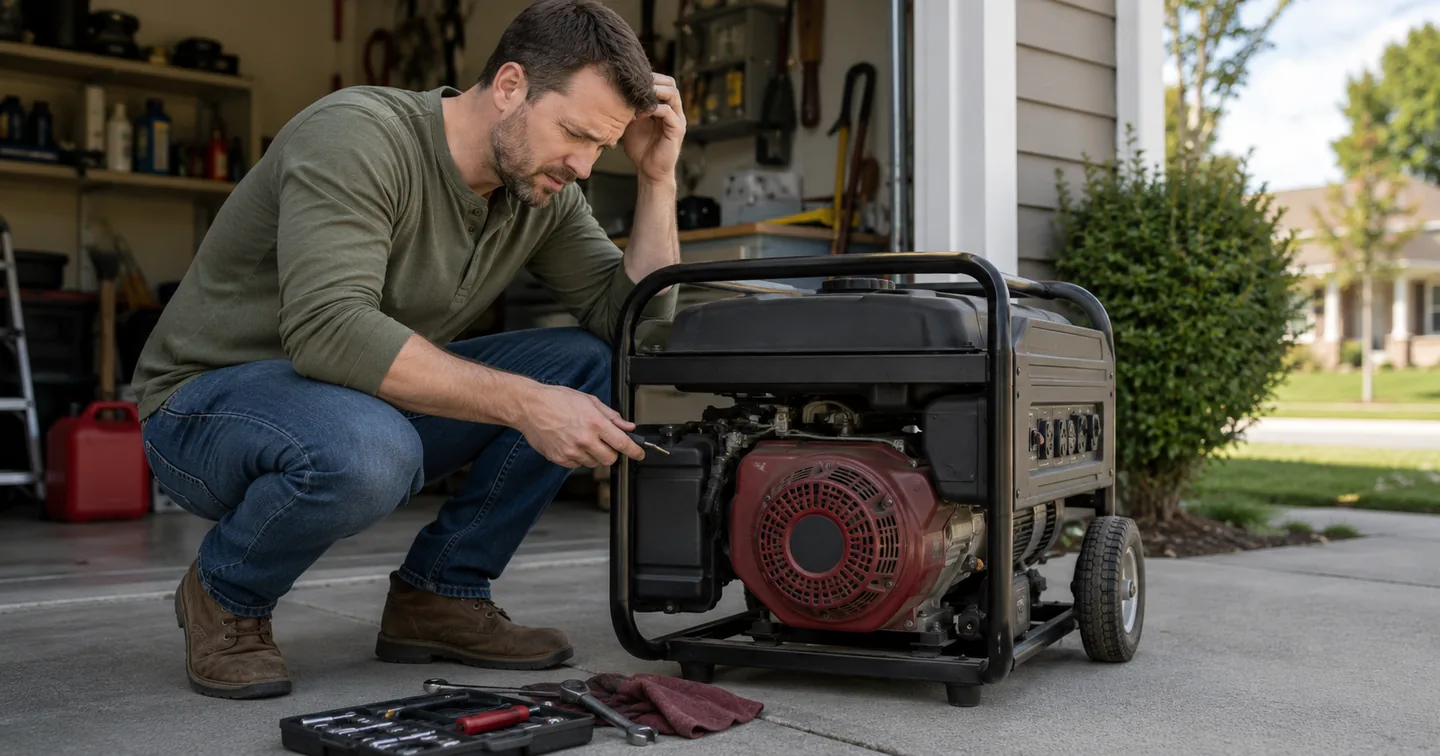
There’s something uniquely annoying about owning a generator for years, finally needing it during an outage, pulling the starter cord—and getting absolutely nothing.
Before assuming the generator is dead, start with the boring stuff.
A portable generator needs fuel, correct oil level, air, ignition, and the controls in the right position.
And if it has been sitting unused for months, old gasoline is immediately high on my list of suspects.
I would work through the simple checks first before taking anything apart.
First: Disconnect the Loads
Before troubleshooting startup, unplug the appliances and extension cords from the generator.
Start the generator unloaded unless the manufacturer’s procedure specifically says otherwise.
Once it is running and stable, loads can be connected according to the operating instructions.
If you’re trying to diagnose a generator while it’s already being asked to power half the house, you’re making the problem harder than it needs to be.
1. Is There Actually Fuel in It?
Start here.
Yes, it’s obvious.
Check anyway.
Make sure the generator has the correct fuel and enough of it.
For gasoline: Is it fresh?
If the machine has been sitting for months with old gasoline in the tank or carburetor, stale fuel may be part of the problem.
Gasoline isn’t something I’d leave in a small engine indefinitely and expect everything to be fine.
If the fuel is questionable, follow the manufacturer’s procedure for removing stale fuel and replacing it with fresh fuel. Generac’s portable generator FAQ and troubleshooting guidance is a useful reminder that the exact owner’s manual remains the right reference for the machine in front of you.
Don’t start randomly disconnecting fuel lines if the manual doesn’t instruct you to.
2. Is the Fuel Valve Open?
Many portable generators have a fuel shutoff valve.
It’s extremely useful during storage. It’s also very easy to forget that you closed it six months ago.
If gasoline can’t reach the engine, it isn’t going to start.
Check the fuel valve, fuel selector, fuel cap vent where applicable, and model-specific fuel controls against the startup instructions in the manual.
On dual-fuel and tri-fuel generators, also make sure you’ve actually selected the fuel source you’re trying to use.
3. Check the Engine Oil
Many portable generators have a low-oil shutdown or low-oil protection system.
If the oil level is too low, the engine may refuse to run.
Place the generator on a level surface and check the oil according to the procedure in the owner’s manual.
Don’t assume every generator’s dipstick is read the same way. Some manufacturers want the dipstick threaded in for a reading. Others don’t. Use the procedure for the machine.
If the oil is low, add the correct oil to the correct level. Don’t overfill it.
For the ongoing maintenance side, see How Often Should You Change Generator Oil?.
4. Is the Generator Actually Switched On?
Another obvious one worth checking.
Depending on the generator, you might have an engine switch, ignition switch, fuel-selector dial, start/run dial, battery switch, economy-mode control, or remote-start control.
Make sure the controls are in the proper starting configuration.
A generator with several controls can look completely ready while one little switch is still sitting in OFF.
5. Check the Choke
Cold engines commonly need choke for starting. Warm engines may need much less—or none.
The exact procedure depends on the generator.
For a cold engine, that may mean starting with the choke in START or CLOSED and then moving it toward RUN once the engine starts.
Don’t leave the generator running indefinitely with the choke fully on unless the manufacturer tells you to.
And don’t assume every modern generator even has a manual choke. Some designs control starting differently.
Use the starting procedure on the machine or in its manual.
If It Only Runs With the Choke On
This is a useful clue.
If the generator starts with the choke on but dies as soon as you move it to RUN, the engine may not be getting the correct fuel mixture during normal operation.
Old fuel or a restricted carburetor is one possible cause.
At that point I would stop repeatedly forcing it to run on choke.
Check the manufacturer’s troubleshooting instructions.
If the carburetor needs cleaning or repair and you’re not comfortable doing that work, this is a reasonable point to use a small-engine shop or authorized service center.
6. Check the Spark-Plug Wire
Find the spark-plug boot and make sure it’s securely attached.
It can get knocked loose during storage, transportation, maintenance, or moving the generator around.
You don’t need to disassemble the engine to check whether the wire is actually connected.
If the spark plug itself is due for replacement according to the maintenance schedule—or there are clear signs it’s defective—use the correct replacement specified for the engine.
7. Check the Air Filter
An engine needs air.
If the air filter is severely clogged, the generator may be difficult to start or may run poorly.
Inspect it according to the manual.
Don’t automatically wash every generator air filter in soap and water. Some filters are serviceable. Some need replacement. The correct procedure depends on the filter design.
8. Did You Flood the Engine?
More choke and more starting attempts aren’t always better.
If the engine receives too much fuel, it can become flooded.
This can happen after repeated unsuccessful starts, particularly with the choke engaged.
If you suspect flooding, follow the manufacturer’s procedure.
Often that means giving the excess fuel time to clear and attempting another start with the appropriate choke position.
Don’t just pull the starter 75 more times.
9. Electric Start Doesn’t Mean the Generator Engine Is Dead
If you press the starter and nothing useful happens, the problem may be the starting battery rather than the engine.
Check battery charge, battery connections, corrosion, and battery switch where applicable.
If the generator also has a recoil starter, the manual may allow you to start the engine manually even when the electric-start battery is weak.
That’s one reason I like a recoil backup on an emergency generator.
Just remember the starting battery needs maintenance too.
10. Is the Generator Sitting Level?
This sounds trivial.
It isn’t.
Low-oil sensors can behave incorrectly if the generator is sitting at a bad angle.
Generators should generally be operated on an appropriate stable, level surface according to their manufacturer.
If you’re trying to start it on a steep driveway or some weird pile of landscaping stone, move it to a proper operating position.
11. Did It Sit With Old Gasoline?
If the answer is yes, this moves near the top of my list.
A generator that ran fine last year, sat for months, still has old gasoline in it, and now won’t start or only runs with choke is giving you a pretty obvious clue.
Old fuel can leave deposits in the fuel system and carburetor.
Sometimes replacing stale fuel is enough. Sometimes the fuel system needs service.
This is why storage procedure matters so much with emergency generators. They’re machines that may go through extremely long periods of doing nothing.
For the storage side, read How to Safely Store Gasoline for a Portable Generator.
12. Does It Start and Then Shut Off?
That’s a slightly different problem.
I’d check fuel level, oil level, choke position, air filter, whether the generator is overloaded, any warning lights or fault indicators, and carbon-monoxide shutdown indicator where equipped.
Modern generators with CO shutdown systems may stop if the machine detects unsafe carbon-monoxide accumulation.
If that happens, don’t defeat the safety system. Move the generator to a proper outdoor operating location according to the manufacturer. Current CPSC guidance says portable generators belong outside, well away from the home.
13. It Runs, But There’s No Power
Now we’re dealing with a different branch of troubleshooting.
First, disconnect the loads.
Check whether a breaker has tripped, an overload protection system activated, a GFCI needs to be reset according to the manual, or the equipment you’re plugging in is causing the problem.
If the engine runs normally but the generator produces no usable electrical output after basic manufacturer-approved resets, I’d move toward service rather than experimenting with electrical internals.
This isn’t where I’d start taking apart the generator head because an internet article told me to.
14. Don’t Disable Safety Systems
If your generator has low-oil protection, CO shutdown, overload protection, circuit breakers, or GFCI protection and one of those systems appears to be preventing operation, figure out why.
Don’t bypass it.
The annoying safety system may be the thing keeping a starting problem from becoming a much bigger problem.
A Generator That Won’t Start After Storage Is Usually Telling You Something
The best time to discover a generator won’t start is not during an outage.
I’d test an emergency generator periodically according to its manufacturer’s storage and maintenance guidance.
That lets you catch weak starting battery, stale fuel, low oil, damaged cords, and maintenance that’s coming due while the hardware store is still open and the lights are still on.
What I’d Check in Order
If mine wouldn’t start, I’d go through this list:
- Disconnect all electrical loads.
- Confirm fresh/correct fuel.
- Confirm fuel valve and selector position.
- Check oil on level ground.
- Verify ON/start controls.
- Set choke according to engine temperature.
- Make sure the spark-plug wire is secure.
- Inspect the air filter.
- Check the electric-start battery if applicable.
- Look for warning/fault indicators.
- Think seriously about stale fuel if it sat for months.
If those things don’t solve it, I’d open the troubleshooting section of the manual for the exact model before going deeper.
When I’d Stop Troubleshooting
There is a point where “DIY troubleshooting” turns into engine repair.
I’d stop and consider professional service if fuel is leaking, electrical components appear burned or damaged, wiring is damaged, the engine is mechanically locked, the generator repeatedly trips protective systems for an unknown reason, fresh fuel/basic maintenance don’t resolve a suspected carburetor problem, the machine runs but doesn’t produce power after the normal reset procedure, or you’re simply not comfortable with the repair.
A generator is supposed to be emergency equipment.
I don’t need to prove I can rebuild it in the driveway during the emergency.
Fix the Storage Problem After You Fix the Starting Problem
If stale fuel caused the problem, don’t get the generator running and then put it back in the garage exactly the same way.
Check the storage section of the manual.
Depending on the generator and storage period, the manufacturer may recommend some combination of fresh stabilized gasoline, fuel shutoff, running the carburetor dry, draining the fuel system, and maintaining the starting battery.
Different generators have different storage instructions. Follow the one for yours.
The goal is pretty simple:
The next time the power goes out, you want the generator to be boring.
Fuel on.
Switch on.
Start.
Power.
That’s much better than learning small-engine repair by flashlight.
For the purchase and outage-planning side, see the Portable Generator Buyer’s Guide.
Related guides
guide · Generators
How Often Should You Change Generator Oil?
guide · Generators
How to Safely Store Gasoline for a Portable Generator
guide · Generators