Comparison · Generators
Solar Generator vs. Gas Generator
A portable power station is quiet stored energy; a combustion generator is a practical way to make more power for longer. The right choice depends on the loads and outage plan.
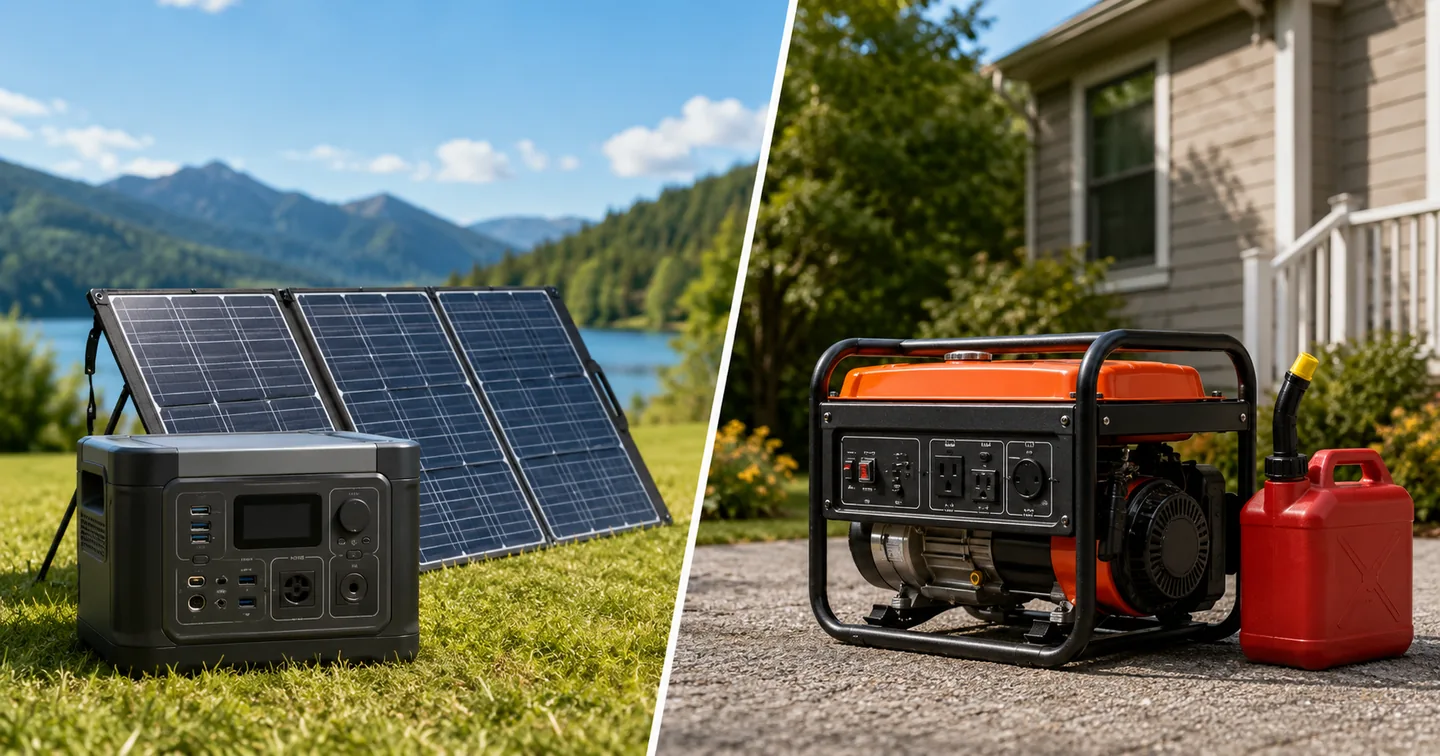
Which One Actually Makes More Sense During a Power Outage?
“Solar generator” is one of those product names that makes the technology sound more mysterious than it really is.
Most of what people call a solar generator is basically:
a large rechargeable battery + an inverter + solar panels
The battery portion is more accurately called a portable power station.
Add compatible solar panels and now you have what the industry commonly calls a solar generator.
A gas generator works completely differently.
It burns fuel and continuously creates electricity while the engine is running.
Neither is automatically better.
They’re good at very different things.
The Short Answer
I’d choose a portable power station / solar generator if I cared most about:
- quiet operation
- powering electronics
- using backup power inside the home without engine exhaust
- low routine maintenance
- short outages
- overnight power
- recharging from solar when conditions allow
I’d choose a gas or multi-fuel generator if I cared most about:
- high continuous output
- large motor loads
- long outages
- rapidly adding more stored energy by adding fuel
- pumps and other demanding household loads
And if I were serious about outage preparedness?
I actually like the idea of having both.
A Solar Generator Doesn’t Generate Power From Nothing
This is worth understanding before shopping.
The power station is a battery.
If it has 2,000 watt-hours of usable stored energy, then you’re working with a finite amount of energy until you recharge it.
Solar panels give you one method of putting energy back into the battery.
They don’t guarantee unlimited power.
Solar production depends on panel wattage, sunlight, cloud cover, season, panel orientation, shading, and the power station’s maximum solar input.
That’s why I would think of solar as recharging capacity, not magical infinite runtime.
Watts and Watt-Hours Are Different
This is probably the most important concept in battery backup.
Watts
Watts tell you how much power the system can deliver at a moment in time.
If your portable power station has a 2,400-watt inverter, that’s roughly the class of simultaneous AC load it was designed to support, subject to its exact specifications and surge behavior.
Watt-Hours
Watt-hours tell you how much energy is stored.
Suppose a battery stores:
2,000 Wh
and your equipment consumes:
500 watts continuously
The simple theoretical math says:
2,000 Wh ÷ 500W = 4 hours
Real usable runtime won’t exactly match that because of inverter losses, battery limits, varying appliance loads, and other factors.
But that’s the concept.
A battery system has both:
How much can I power?
and
How long can I power it?
Those are separate questions.
Gas Generators Work the Other Way Around
A gasoline generator doesn’t come with a fixed number of watt-hours stored inside it.
Its stored energy is your fuel supply.
If the generator has enough fuel, it keeps producing electricity.
Run low? Add more fuel after shutting down and allowing the generator to cool as instructed.
That’s a huge advantage during a long outage.
If you’re trying to power high-energy loads for several days, storing another container of fuel can be much easier and cheaper than adding another large battery module.
Battery Power Is Wonderful at Night
This is where I think portable power stations are fantastic.
Imagine running a generator during the day to handle pumps, refrigeration, battery charging, and other heavy loads. Then you shut the engine off at night.
A power station handles CPAP, refrigerator, internet, phones, lights, television, and small electronics quietly.
No engine noise. No fuel. No exhaust.
That’s a much more pleasant way to spend the night during an outage.
A Power Station Can Be Used Where a Combustion Generator Cannot
A gas, propane, or natural-gas portable generator produces carbon monoxide. It belongs outside.
A portable battery power station has no combustion engine and does not create engine exhaust while providing electricity. That makes it fundamentally different for indoor backup use.
You should still follow the battery manufacturer’s instructions for ventilation, charging, temperature, storage, moisture, and safe operating conditions.
But you’re not dealing with carbon-monoxide exhaust from an engine sitting next to you.
That’s a major advantage.
Gas Wins at Quickly Adding More Energy
This may be the biggest practical difference.
If my gas generator is almost empty and I have another approved container of gasoline available, I can add a substantial amount of stored energy relatively quickly after safely shutting down and cooling the machine for refueling.
If my 2-kWh power station is empty, I have to recharge it.
That could happen through utility AC power, solar, a vehicle, another generator, or another supported charging source, depending on the machine.
During a blackout, wall charging may not be available. Which means your ability to replenish the battery becomes part of the emergency plan.
Solar Recharging Is Great—When the Sun Cooperates
I like solar. I just wouldn’t design an emergency system around fantasy solar conditions.
A panel rated for 400 watts does not mean you’ll receive 400 watts every minute from sunrise to sunset.
Real solar charging varies.
If it’s cloudy, raining, winter, heavily shaded, or late in the day, you may collect substantially less energy.
The larger your battery and daily energy usage, the more solar panel capacity becomes important.
For a camping trip, that’s manageable. For several days of home backup during terrible storm weather—the exact weather that may have caused the outage—I’d want another charging option too.
Noise Is Not Even Close
Battery wins.
A power station has fans and electronics, but it doesn’t have a gasoline engine running continuously.
If you’re using backup power at night, around neighbors, while camping, or around a home office, that matters.
A modern inverter generator can be dramatically nicer to live around than an old open-frame generator. It’s still an engine.
Maintenance Is Not Even Close Either
Battery wins here too.
A combustion generator has engine oil, spark plug, air filter, fuel, carburetor or fuel system, starting battery on some models, and other engine maintenance.
A portable power station removes most of that.
The battery itself still ages and needs to be stored and charged according to its manufacturer’s requirements. But there is much less mechanical maintenance.
Which Is Better for a Refrigerator?
Either can be.
A refrigerator has relatively modest running consumption but a compressor startup requirement.
A properly sized power station can handle one very nicely, especially if you’re trying to keep the refrigerator running quietly overnight.
The more useful question is:
How many watt-hours will the refrigerator use over the outage?
That’s what determines battery runtime.
A gas generator doesn’t care nearly as much about that energy-budget calculation as long as you continue supplying fuel.
Which Is Better for a Well Pump?
This is where I start leaning generator.
Well pumps can have large startup surges, substantial power requirements, and 240V requirements.
There are battery systems capable of running them. But you need to check inverter output, surge capacity, voltage, battery capacity, and connection method carefully.
I wouldn’t assume a portable power station can run a well pump because the marketing page says it can power “99% of appliances.”
Look at the pump. Then look at the electrical specifications.
Which Is Better for a Sump Pump?
This one could go either way.
A sufficiently capable battery system can be very useful for a sump pump because it can provide power without starting an engine every time the pump cycles.
But sump pumps can also have large startup surges. And during the kind of storm that knocks out electricity, your sump pump may be running frequently.
That’s exactly when stored battery energy can disappear faster than expected.
For a serious flooding risk, I’d want a backup plan with enough energy depth for the outage I’m expecting.
Which Is Better for Heat?
If we’re talking about a gas furnace blower, either can potentially work if correctly sized and properly connected.
If we’re talking about running electric resistance heat from a portable battery? That gets expensive in energy very quickly.
A 1,500-watt space heater consumes:
1.5 kWh every hour it runs continuously.
That’s most of a 2-kWh battery in roughly an hour of theoretical full-power operation.
Battery systems are great. Turning electricity into continuous resistive heat is still energy-intensive.
What About Air Conditioning?
Same basic story.
Small window units can be reasonable depending on the power station.
Large central AC becomes a much more serious backup-power problem.
Don’t just look at running watts. Air conditioners can have significant compressor startup demand.
And even if the power station can start the unit, you need enough battery capacity to run it for a useful amount of time.
Upfront Cost
Per unit of high-output backup capability, a conventional portable generator can still be remarkably inexpensive.
Battery systems become expensive when you start adding large inverter output, several kilowatt-hours of battery capacity, expansion batteries, and substantial solar arrays.
But that’s not the whole value equation.
You’re also buying quiet, indoor usability, minimal mechanical maintenance, easy everyday use, solar charging, and power that can be useful outside emergencies.
Whether that’s worth the premium depends on how you’re using it.
What I Like: Battery + Generator
If I were building a portable outage system rather than choosing one product for an article title, this is where I’d probably end up.
I’d use a power station for nighttime, electronics, refrigerator, internet, CPAP, lights, and quiet periods.
Then I’d have a generator available for high-demand loads, pumps, long outages, and recharging the battery when solar isn’t enough.
That gives you something a generator alone doesn’t provide:
quiet stored power
and something a battery alone doesn’t provide:
a relatively easy way to keep adding large amounts of energy during a long outage.
When I’d Buy Only the Solar Generator
I’d be comfortable with only a power station/solar setup if outages are normally short, my loads are modest, I don’t need large pumps or HVAC, I can keep the battery charged ahead of time, I have enough solar input for the way I plan to use it, and quiet/indoor backup matters more than very long runtime.
For an apartment or townhouse where safely operating a portable combustion generator may not be practical, a battery system is especially interesting.
When I’d Buy Only the Gas Generator
I’d choose the engine generator first if outages can last for days, I have a well, I need substantial 240V capability, I have large motor loads, budget matters, I can safely store/access fuel, and noise is an acceptable tradeoff.
A generator is difficult to beat when the job is simply:
Make a lot of electricity for a long time.
My Choice
For short outages and everyday usefulness, I like the power station.
For severe multi-day outages, I still trust an engine generator more as the primary energy source.
For the best actual experience?
I’d rather have both than massively overspend trying to make either one behave exactly like the other.
They’re different tools.
Treating them that way makes the decision much easier.
For the related generator decisions, use the portable generator buyer’s guide, wattage calculator, and gas vs. propane vs. dual-fuel comparison.
Two examples that show the tradeoffs
Best Compact Power Station
EcoFlow DELTA 3 Plus Portable Power Station
EcoFlow
Mid-range
This is the one to compare when you are thinking beyond a self-contained battery box and toward an expandable battery system. Confirm what the exact listing includes; expansion batteries are a separate part of that larger-system decision.
Check current price at AmazonGas Generator Alternative
Honda EU2200i / EU2200iTAG Portable Inverter Generator
Honda
Premium
This is a useful combustion-generator alternative for modest loads because, with a safe outdoor setup and fuel, it can keep producing power rather than drawing down a battery. It is not equivalent to these power stations: it trades quiet indoor use for a fuel, noise, exhaust, and maintenance routine.
Check current price at AmazonRelated guides
guide · Generators
Portable Generator Buyer's Guide
guide · Generators
What Size Portable Generator Do I Need?
comparison · Generators