Guide · Buying Guides
What Size Lawn Mower Do I Need? Measure the Lawn, Then Compare the Time
Choose a mower width using actual grass area, gate clearance, and transparent mowing-time estimates for 21-, 24-, 30-, and 42-inch decks.
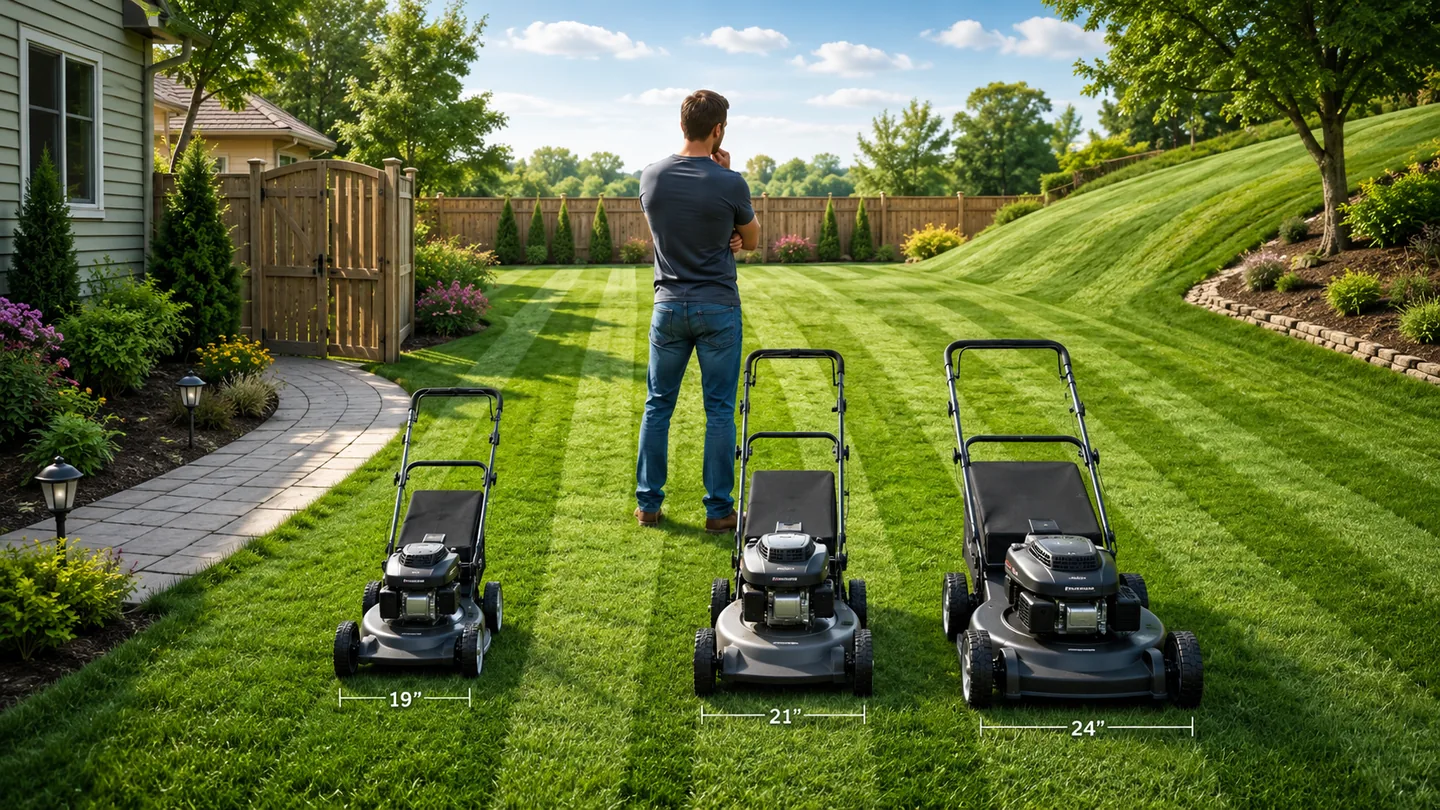
Buying a wider mower can save time every week. It can also leave you with a machine that barely fits through the gate and takes three attempts to turn around a flower bed.
Before looking at deck sizes, measure the grass you actually cut. Then measure the route the mower has to take to reach it.
The Short Answer
For a typical suburban lawn, I’d start by looking at 20- to 22-inch walk-behind mowers. Compare smaller machines when access and turning room are tight. Compare a wider walk-behind or riding mower when there is enough open grass to use the extra width.
Those are shopping starting points. The useful question is how much time a bigger mower would save on your property.
| What your yard is like | Where I’d start | What could change that choice |
|---|---|---|
| Small lawn with narrow passages and frequent turns | Compact walk-behind, roughly 16–19 inches | A standard mower may still fit and be easier to find parts for |
| Ordinary suburban lawn with mixed open areas and landscaping | Walk-behind, roughly 20–22 inches | Gate clearance, physical effort, or a long mowing route |
| Substantial open lawn; walking is fine but mowing takes too long | Compare 24–30-inch walk-behinds | Weight, storage, and turning space may erase the benefit |
| About an acre of actual, mostly open grass | Compare riding equipment with a wide walk-behind | Terrain, access, and whether you want to walk for that long |
These ranges are editorial guidance, not manufacturer acreage ratings or safety limits.
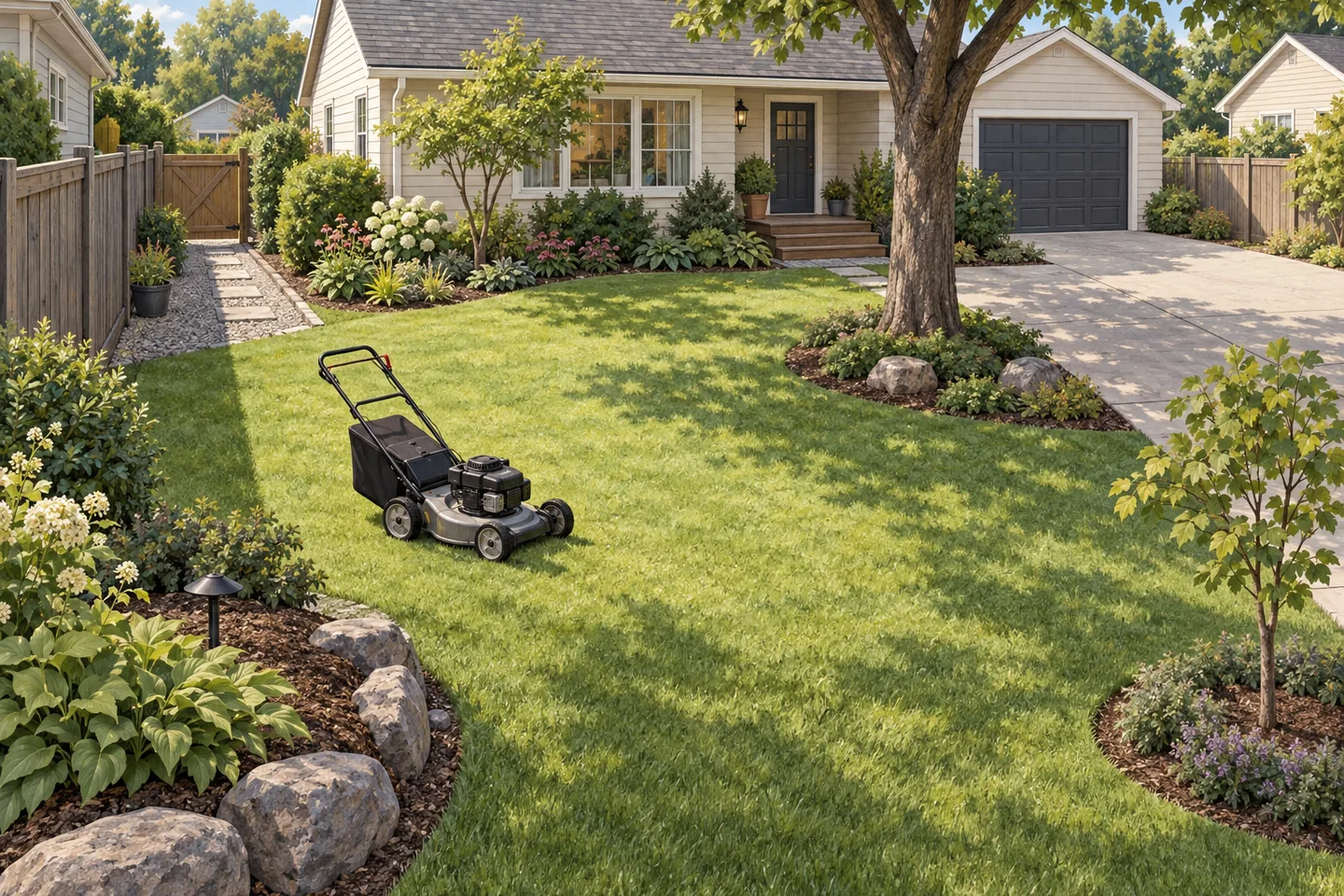
Measure grass area without making it a project
You don’t need a survey. Break the lawn into a few rectangles and triangles and estimate each section.
For a rectangle, multiply length by width. For a triangle, multiply base by height and divide by two. Add the sections together. Divide square feet by 43,560 to convert to acres.
Here’s a made-up property:
| Grass section | Calculation | Area |
|---|---|---|
| Front lawn | 60 × 40 feet | 2,400 sq. ft. |
| Back lawn | 80 × 70 feet | 5,600 sq. ft. |
| Side strip | 10 × 100 feet | 1,000 sq. ft. |
| Total | 9,000 sq. ft., about 0.21 acre |
The listing might call that a half-acre property. The mower is handling about a fifth of an acre. That difference can change the purchase completely.
How much mowing time does width actually save?
The table below is a calculation, not a mower test. It assumes a steady 2.5 mph for walk-behinds and 4 mph for the rider, with 75% efficiency to allow for overlap and ordinary turns. It excludes bag emptying, charging, trimming, setup, and cleanup.
The speed assumptions are for comparison on suitable open ground. They are not recommended speeds for every yard.
| Cutting width and assumed speed | 10,000 sq. ft. of grass | Half an acre of grass | One acre of grass |
|---|---|---|---|
| 21 inches at 2.5 mph | 35 min | 75 min | 151 min |
| 24 inches at 2.5 mph | 30 min | 66 min | 132 min |
| 30 inches at 2.5 mph | 24 min | 53 min | 106 min |
| 42 inches at 4 mph | 11 min | 24 min | 47 min |
The formula is:
Minutes = grass area in square feet ÷ [(cutting width in inches ÷ 12) × speed in mph × 88 × efficiency].
Use 0.75 for 75% efficiency. The 88 converts miles per hour to feet per minute. Our efficiency value is an illustrative assumption; it is not a measured average for homeowners.
On half an acre, the example saves about nine minutes by moving from 21 to 24 inches. Moving from 21 to 30 inches saves about 23 minutes. If the wider machine creates ten extra minutes of maneuvering and cleanup, some of that saving disappears.
For another way to look at it, a 24-inch deck is about 26% wider than a 19-inch deck. At the same speed, with no extra complications, that reduces straight-line cutting time by about 21%. More width and less time use different denominators. Neither number is a promise about your entire Saturday morning.
Check the bottleneck before spending money
Time one normal mowing session. Separate the minutes spent cutting from the minutes spent emptying the bag, moving equipment, opening gates, or waiting for batteries.
If cutting takes 35 minutes and bagging interruptions take another 25, a wider deck only addresses part of the job. If you spend 90 minutes making long passes across open grass, deck width deserves more attention.
Self-propelled drive addresses physical effort. It doesn’t remove the walking. A rider changes both the equipment and the amount of walking, but brings its own storage and service needs.
The cutting width is not the machine width
Measure the narrowest usable opening with the gate fully open. Check the latch, posts, hinges, and the turn immediately before and after it.
Then look up the mower’s overall width in the configuration you’ll actually use. Wheels, the deck housing, and a discharge chute may extend beyond its cutting path. A nominal 30-inch deck does not establish that the mower fits a 30-inch opening.
Leave room to guide it through comfortably. If fitting requires removing a guard or holding a discharge shield out of the way, choose another mower or another access route.
Slopes can rule a mower out
Treat terrain as an operating constraint. Self-propelled drive and all-wheel drive do not establish a safe slope limit.
Read the exact mower manual for slope limits, mowing direction, and conditions to avoid. A walk-behind and a riding mower may have different instructions. Steep banks can be better candidates for a different landscape treatment, as University of Minnesota Extension explains.
What I’d write down before shopping
My shortlist would start with five numbers: actual grass area, narrowest opening, available storage footprint, current mowing time, and the time I’d like to get it down to.
That gives a mower dealer something useful to work with. It also makes it easier to see whether a wider machine solves the problem.
For the next decision, read our guides to a half-acre lawn or one acre of grass. If charging interruptions are the issue, start with battery runtime.
How this guide was prepared: the time table is our own calculation using the stated assumptions. It is not hands-on performance data. Operating guidance is linked where it affects the decision.
Related guides
guide · Yard size
What Mower Do You Need for Half an Acre? Start With the Actual Grass

guide · Yard size
What Mower Makes Sense for One Acre? Compare the Time Before Buying
guide · Buying Guides