Guide · Buying Guides
Battery Mower Won’t Finish the Yard? Check This Before Buying Another Battery
Separate a runtime shortage from overheating or a mower fault, measure your actual mowing job, and decide whether another battery would help.
Getting three-quarters of the way through the lawn and waiting for a charger is frustrating. It also doesn’t tell you, by itself, whether you need another battery.
The mower may have used its available charge. It may be stopping because the cutting load is too high. A protective shutdown or an equipment fault can look like poor runtime if you don’t check what happened.
The Short Answer
First find out whether the battery is actually empty when the mower stops. Read the indicator using the exact mower and battery manuals.
Then record how much grass the setup completes under normal conditions. If the mower works normally but consistently runs out before finishing, compare the cost of sufficient compatible battery capacity with the alternatives. If it repeatedly stops with charge remaining, investigate that behavior before spending money on another pack.
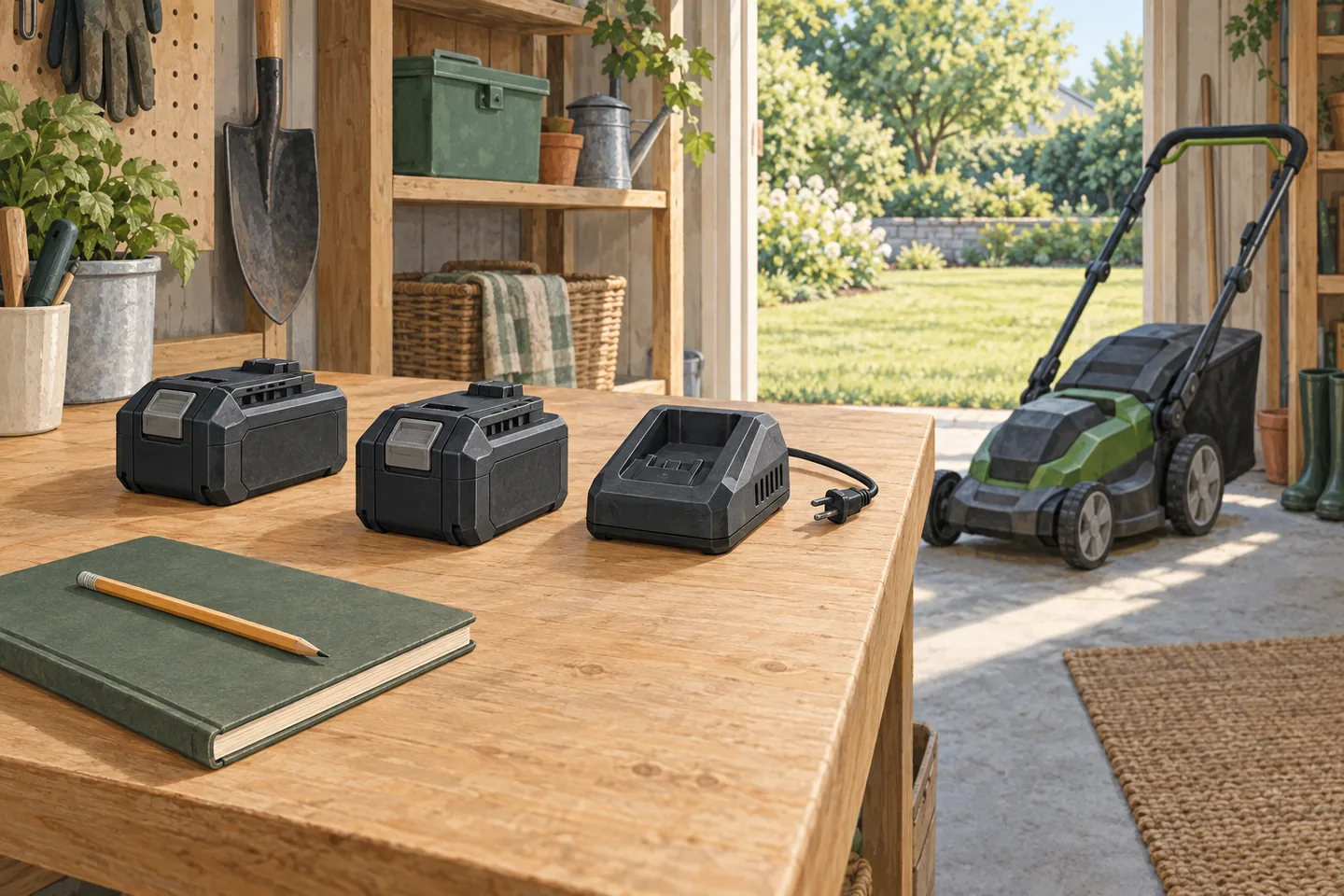
Start with what happens when it stops
| What you observe | What to investigate | Useful next step |
|---|---|---|
| Low-charge indication after an otherwise normal session | The job may exceed available runtime | Measure the portion completed and remaining |
| Temperature or overload indication | Protective shutdown | Follow that model’s cooling or load-reduction instructions |
| Stops when the handle moves or immediately after starting | Setup, interlock, connection, or other fault | Check the manual’s start/stop troubleshooting; don’t bypass switches |
| One compatible pack behaves much worse than another in similar work | A possible battery or charging problem | Record the comparison for manufacturer support |
| Repeated unexplained stops despite correct setup | A problem beyond a simple capacity shortage | Use the warranty or service process |
The table is a way to organize symptoms, not a diagnosis. Indicator colors and meanings differ between models.
For example, the EGO LM2130/LM2150SP family manual separates low charge, overload, overheating, and handle-position problems. Its troubleshooting section also says the advertised runtime is based on a light load. Those details apply to the listed models; use your own manual for the equivalent checks.
Compare the same job before blaming the battery
“It used to do the whole yard” is useful evidence if the yard and mowing routine are comparable.
Did the grass grow longer between cuts? Are you taking more off the top? Are you now bagging? Did you move to a property with more actual grass? Is the mower cutting cleanly, or are you making repeat passes?
Don’t make the comparison by mowing wet grass. Use suitable dry conditions and the cutting height appropriate for your grass. University of Minnesota Extension recommends removing no more than one-third of the grass blade at a mowing. Its height guidance is for the cool-season lawns discussed there; it is not a universal height for every species.
Check routine maintenance too. Stop the mower and isolate its power as instructed before examining or cleaning it. Follow the cleaning method for that model; don’t assume every electric mower can be washed with a hose.
Keep a short mowing log
For three ordinary sessions, record these details:
| Detail | What to write down |
|---|---|
| Mower and battery | Exact model numbers, capacity, number of packs |
| Grass area | Estimated square feet actually cut |
| Conditions | Dry grass, approximate starting height, mowing setting, days since last cut |
| Mode | Mulching, bagging, or approved discharge configuration |
| Cutting time | Time with the mower operating; record breaks separately |
| Result | Finished or unfinished; estimated grass area left |
| Reason for stopping | Low charge, displayed fault, or something else |
A log can reveal that you are consistently short of energy, or that a specific battery or condition produces the problem. It also gives support something concrete to work from.
Estimate the shortfall before pricing batteries
Suppose one fully charged, compatible 6Ah battery consistently completes about 70% of your lawn before its normal low-charge stop.
If the remaining grass requires the same work per square foot, the current job needs about 1 ÷ 0.70 = 1.43 times the energy you had available. On that same battery platform, 6Ah × 1.43 ≈ 8.6Ah is a rough capacity equivalent for the whole job under those conditions.
That does not guarantee a particular larger battery finishes it. It assumes comparable battery condition, usable capacity, cutting load, and mower behavior. A nominal 9Ah pack would also leave little allowance in this example for harder mowing.
Use the calculation to see the size of the gap. Then compare approved battery options and the cost of having adequate margin. If the unfinished section is steeper or thicker, area alone will underestimate the remaining work.
Amp-hours only compare directly within a comparable voltage system
Don’t compare a 6Ah pack from one voltage system with a 6Ah pack from another and assume equal stored energy.
Energy in watt-hours is voltage multiplied by amp-hours when the ratings use a consistent basis. Manufacturer voltage labels can use different conventions, so prefer a documented Wh rating for cross-system energy comparisons.
Even equal Wh does not prove equal mowing time. Motors, decks, cutting loads, and operating settings also affect what the mower accomplishes.
Can a faster charger solve it?
Sometimes, but calculate the timing.
If a battery provides 25 minutes of your normal mowing and takes 60 minutes to recharge, alternating two packs leaves the first pack well short of a full charge when the second runs out. A hot pack may also have to cool before charging begins.
The 25 and 60 minutes are hypothetical. Look up the charging time for your battery and charger combination. EGO’s battery comparison page, for example, lists different times for the same battery on different chargers.
For some yards, more ready-to-use capacity is simpler than planning mowing around charging. For others, one planned break is acceptable. Price the routine you actually want.
When I’d buy another battery
I’d consider another approved pack when the mower cuts well, shows a normal low-charge stop, and the extra capacity covers a measured shortage at a sensible cost.
I’d contact support first if one pack behaves abnormally or stops remain unexplained. I’d compare other mower options if enough battery capacity becomes expensive and still leaves me with a cutting width or mowing time I dislike.
Do not open a battery pack, jump its terminals, or bypass protection to chase more runtime. Use the manufacturer’s service route for a damaged or faulty pack; EGO’s battery instructions are one example of the restrictions on damaged packs and servicing.
Why we wrote this: owners repeatedly ask about unfinished lawns and inconsistent runtime, including this lawncare discussion and this RYOBI discussion. They informed the questions here. They are not evidence of a brand-wide failure rate. The calculations are illustrative, not battery tests.
Related guides

guide · Buying Guides
What Size Lawn Mower Do I Need? Measure the Lawn, Then Compare the Time

guide · Yard size
What Mower Do You Need for Half an Acre? Start With the Actual Grass
comparison · Comparisons