Comparison · Chainsaws
Battery vs. Gas Chainsaw: Compare the Whole Ownership Routine
Compare cordless and gas chainsaws using workload, charging, fuel storage, maintenance and complete ownership costs before choosing a saw.
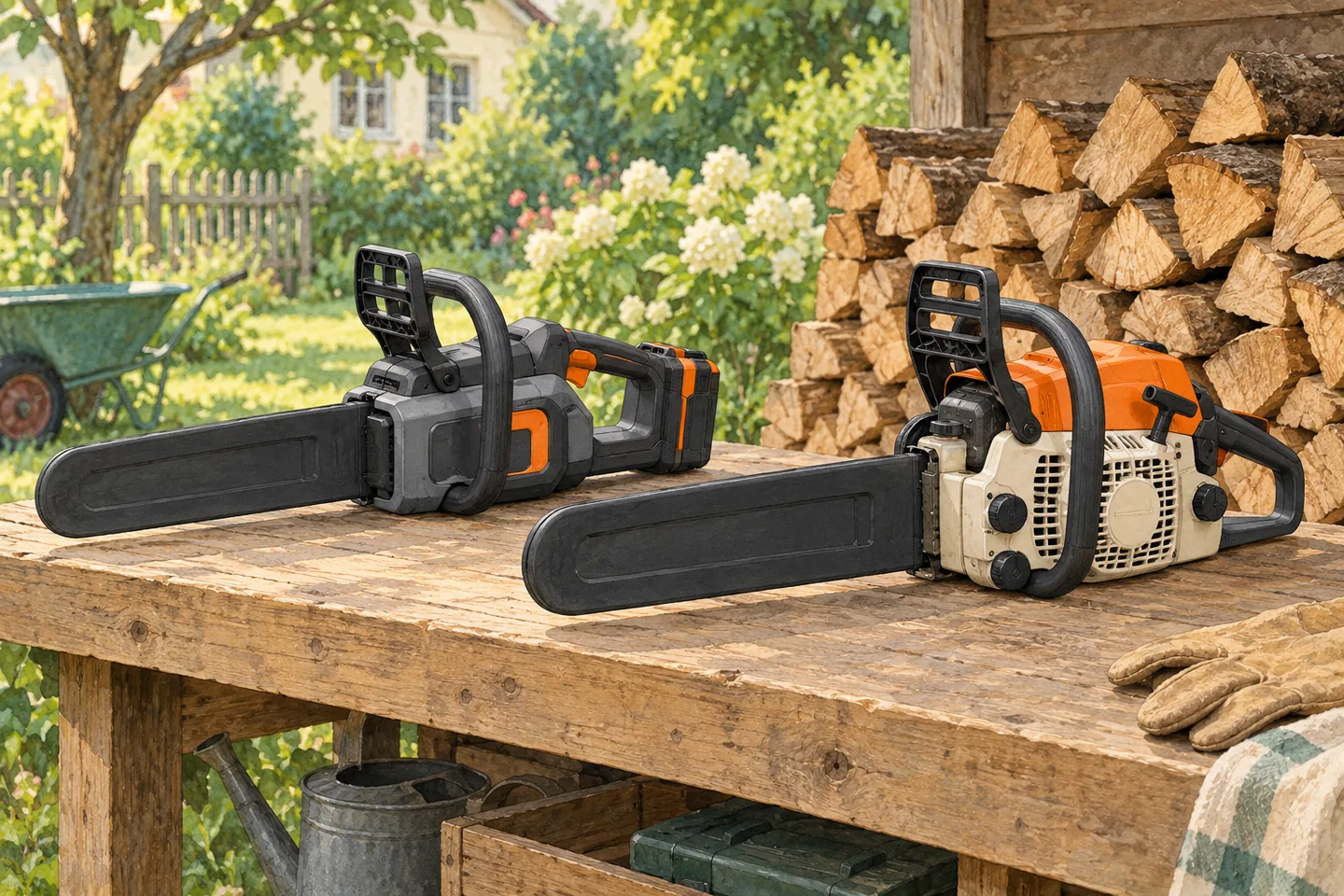
AI-generated illustration: battery and gas chainsaws have different power and maintenance routines.
The difference between battery and gas chainsaws becomes most obvious when you take one out after months of storage. A charged battery avoids starting a small engine. A gas saw avoids waiting for charging when you have suitable fuel and a long job ahead. Neither advantage tells the whole story.
Start with how often you cut and what happens between cutting sessions. Those two questions usually matter more than whether you consider yourself a battery-tool person or a gas-tool person.
The Short Answer
I would start with battery for occasional homeowner work, especially when compatible batteries already have other uses. For regular cutting away from charging, gas deserves a closer comparison. A battery saw can still suit frequent work when the battery plan is adequate; gas is not reserved for professionals.
Do not use power source as a shortcut to saw size or safety. Compare specific configurations and the complete purchase. Neither type makes unstable storm debris, overhead cutting or unfamiliar tree work an appropriate do-it-yourself job.
Compare the ownership routine
| Question | Battery saw | Gas saw |
|---|---|---|
| What prepares it for a session? | Charged compatible battery, inspected cutting equipment and oil | Correct fuel, inspected cutting equipment, oil and the engine’s starting procedure |
| What extends the job? | More charged capacity or time to recharge | More suitable fuel, with the shutdown/cooling procedure required before refueling |
| What happens during long storage? | Follow the battery and tool storage instructions | Follow the engine and fuel-system storage instructions |
| What maintenance remains? | Chain, bar, lubrication and the rest of the saw | Those same cutting-system jobs plus engine-related service |
| What existing equipment helps? | Compatible batteries and chargers | Familiar fuel supplies and a suitable servicing shop |
For both, follow the manufacturer instructions and wear the specified protective equipment. Keep ordinary chainsaw work at waist level or below and get professional help for tensioned debris or work near power lines. CDC chainsaw guidance.
Match the battery supply to a real session
An advertised number of cuts is not a universal measure of runtime. Uniform lumber, irregular branches and dense logs put different demands on the tool. A product’s test conditions belong beside its result.
For example, the EGO CS1613 is a sixteen-inch saw packaged with a 4Ah battery and charger. That tells you what you are buying, not how many hours of your particular cleanup it will finish. EGO configuration details.
Think about whether you cut briefly and then move material, or repeatedly cut prepared logs. In the first routine, one charged pack may cover your session. In the second, a spare becomes more important. If the same batteries also power your mower and blower, count the capacity left for the whole day’s work.
Two batteries do not guarantee continuous operation. A depleted pack may need time to cool before charging, and charging can take longer than using it. Check the battery and charger instructions instead of assuming a spare creates an endless rotation.
Gas works well when the fuel routine is already part of your life
A gas saw can be attractive for recurring work far from a power supply. You are carrying fuel rather than a finite set of charged batteries. But the engine needs the correct fuel and storage care, and refueling is an interruption too.
The Husqvarna 455 Rancher is one larger homeowner example. Its twenty-inch configuration and 55.5cc engine place it in a different comparison from a compact cordless cleanup saw. That does not prove gas always cuts faster; it shows why the actual models must be considered. Husqvarna specifications.
A nearby shop matters if you do not want to handle engine problems yourself. Before purchase, ask whether it services the exact saw and how parts are obtained. A familiar brand without convenient support may be less useful to you than another well-supported model.
Compare the complete cost, not the box price
Use this worksheet with actual offers. Leave out items you already own and can genuinely reuse.
| Cost to enter | Battery purchase | Gas purchase |
|---|---|---|
| Saw | Kit or bare-tool price | Exact saw/bar configuration |
| Power supply | Required batteries and charger | Suitable fuel supplies and approved container |
| Longer sessions | Extra batteries or charging arrangement | Additional fuel and scheduled engine service |
| Both types | Protective equipment, training, oil, sharpening and replacement cutting parts | Same shared costs |
Do not subtract an imaginary resale value or assume a battery will last a fixed number of years. Check actual warranty terms and replacement costs. A cheap tool with an expensive missing battery can lose its price advantage immediately.
The same reasoning applies to an existing gas saw. Replacing it with cordless might remove chores you dislike, but a functioning saw does not become worthless because a different technology is convenient.
Which one is quieter and easier to carry?
Battery eliminates engine idling, but it does not eliminate cutting noise or the need for hearing protection specified in the manual. Compare sound figures only when the measurement method and location match.
Weight also needs consistent definitions. A gas powerhead weight without bar, chain or fluids cannot be fairly compared with a complete cordless kit. The chosen battery can materially change how the cordless saw feels. Our chainsaw sizing guide explains that comparison.
My choice for common homeowner situations
For short, infrequent jobs, I would investigate the EGO CS1613 or a suitable tool within a system I already own. For an established Makita LXT setup, the XCU04PT1 kit is another example worth pricing carefully.
For regular larger work away from charging, I would compare the 455 Rancher with other appropriate gas models and local support. If all the work stays near a suitable outlet, remember the corded Oregon CS1500 as a third option. Choose the routine you can reliably maintain, then the saw that fits the work.
Research checked September 7, 2026. This is a researched buying guide, not our own hands-on test.
Related guides
comparison · Chainsaws and pole saws
Chainsaw vs Pole Saw: Which One Do You Need?
guide · Gas cans