Guide · Chainsaws
What Size Chainsaw Do I Need? Compare the Saw, Not Just the Bar
Choose a chainsaw by recurring work, bar length, cutting capability and complete weight, with specific cordless and gas examples.
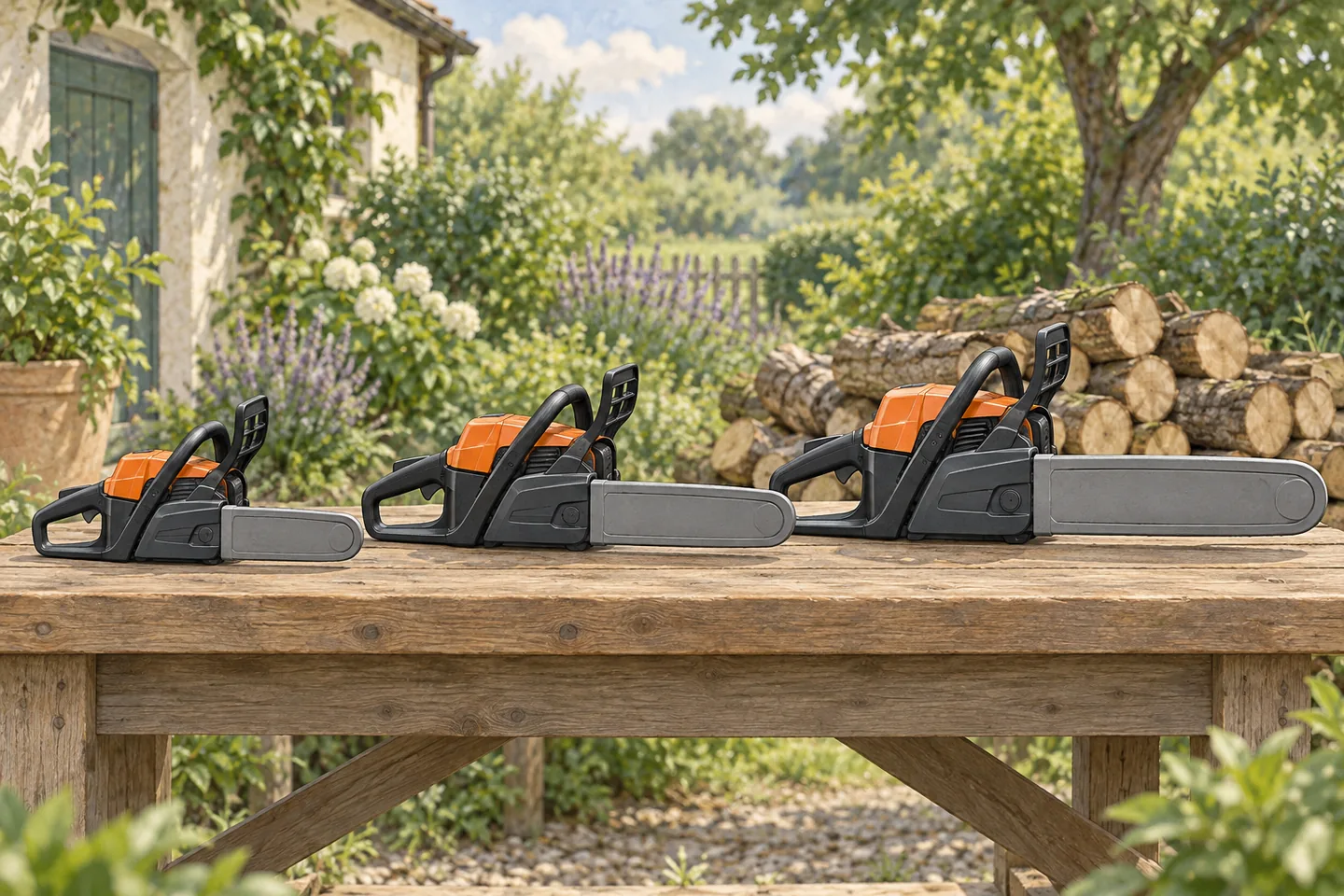
AI-generated illustration: choose a saw for your regular work and manageable weight; this is not a scale diagram.
A twenty-inch bar looks like more chainsaw than a sixteen-inch bar. Sometimes it is. Sometimes you are mainly looking at a longer cutting attachment on a machine that will still be slow or tiring for the work you have in mind.
The useful question is what you need to cut repeatedly, where you will work, and what complete saw you can control. A chainsaw purchase should not be sized around the largest fallen tree you have ever seen.
The Short Answer
For occasional small ground-level cutting jobs, start by comparing compact saws and decide whether you need a chainsaw at all. For more frequent homeowner cutting, a sixteen-inch cordless configuration is a sensible comparison point. For repeated larger wood and work away from charging, investigate a suitable gas saw with local service support.
Those are shopping categories, not safe-cutting limits. The diameter of a log does not tell you whether it is stable or under tension. Leave damaged trees, difficult storm debris and work near structures or power lines to a qualified professional.
Three sizes to put in context
| Example | Documented configuration | Why it belongs in the comparison |
|---|---|---|
| DEWALT DCCS620P1 | Twelve-inch cordless saw; 5Ah kit | Compact option for occasional smaller jobs; an older generation worth comparing with current alternatives |
| EGO CS1613 | Sixteen-inch cordless saw; 4Ah kit | Middle option for an owner wanting a complete cordless setup |
| Husqvarna 455 Rancher | Twenty-inch gas configuration; 55.5cc engine | A regular-work option where carrying and maintaining a larger gas saw is justified |
The DEWALT package is described in Toolguyd’s DCCS620 review. EGO distinguishes its bare tool and battery kits in its CS1610/CS1611/CS1613 configuration table. Husqvarna documents the engine and cutting configurations on its 455 Rancher page.
These are examples from different classes, not a performance ranking. Our individual DEWALT, EGO and Husqvarna reviews explain the ownership tradeoffs.
Bar length and cutting capability are different
The bar guides the chain. Its length is one part of the cutting setup, but it is not a measurement of motor output, engine power or how quickly the saw will complete a particular cut.
A longer chain still has to be driven through the wood. That is why fitting a longer bar does not automatically turn a compact saw into a larger-work machine. Use only configurations the manufacturer supports. A bar that can be physically attached is not enough evidence of compatibility.
For gas models, engine displacement helps identify the general class, but it does not settle performance by itself. For cordless models, the voltage printed on the battery is even less useful as a universal ranking. The motor, battery, chain and complete design all matter.
Separate the usual job from the occasional exception
Write down the work from the last year. Small cleanup jobs? Prepared logs for occasional firewood? Regular wood processing? Do the jobs happen near the house or far from a charger?
A compact saw that is convenient for twenty routine jobs can be a better purchase than a large saw bought for one unusual problem. That unusual job may be better handled by someone with suitable equipment and experience.
The opposite is also true. If larger cutting is genuinely routine, buying an undersized tool because it can eventually complete one cut may be frustrating. Toolguyd’s older DCCS620 test illustrates this distinction: the saw handled larger material, but the reviewer found that work slow enough to prefer another class for repeated use. That is an argument about workload, not a promise of cutting capacity.
Compare complete weights
Husqvarna lists the 455 Rancher at 13.2 pounds without cutting equipment. Add the bar, chain and fluids and you have a different number to carry. Do not compare that figure directly with a battery saw weighed with its battery installed. Husqvarna weight definition.
Ask what each published weight includes. If the answer is unclear, record it as unclear instead of declaring a winner by a few ounces. Handling the complete saw, powered off with its cover fitted, can tell you something a mismatched weight table cannot.
Also consider transport and storage. A larger cutting attachment needs more room in a vehicle or shed. A saw that is annoying to carry before any cutting begins may not be the right everyday tool.
The diameter is only one part of the job
A small branch caught under other wood can be more dangerous than a larger, properly supported log. Bent or trapped material may move suddenly when released. Buying a longer bar does not solve that problem. CDC guidance on tensioned limbs.
This guide does not teach felling, overhead cutting or techniques for oversized logs. Get training appropriate to the work, follow the exact manual and use its specified protective equipment. For reach problems, read chainsaw versus pole saw before choosing either tool.
What I would buy
For occasional small work, I would compare a manageable compact saw with a manual alternative. For recurring moderate homeowner cutting, I would investigate the sixteen-inch cordless class and its battery costs. For frequent larger work away from charging, I would compare an appropriate gas model with a clear service plan.
I would buy the saw that fits most of the year’s work and hire out the exceptions. Our battery versus gas comparison covers the next decision: how you will keep that saw ready to use.
Research checked September 7, 2026. This is a researched buying guide, not our own hands-on test.
Related guides
comparison · Chainsaws and pole saws
Chainsaw vs Pole Saw: Which One Do You Need?
comparison · Chainsaws