Guide · Buying Guides
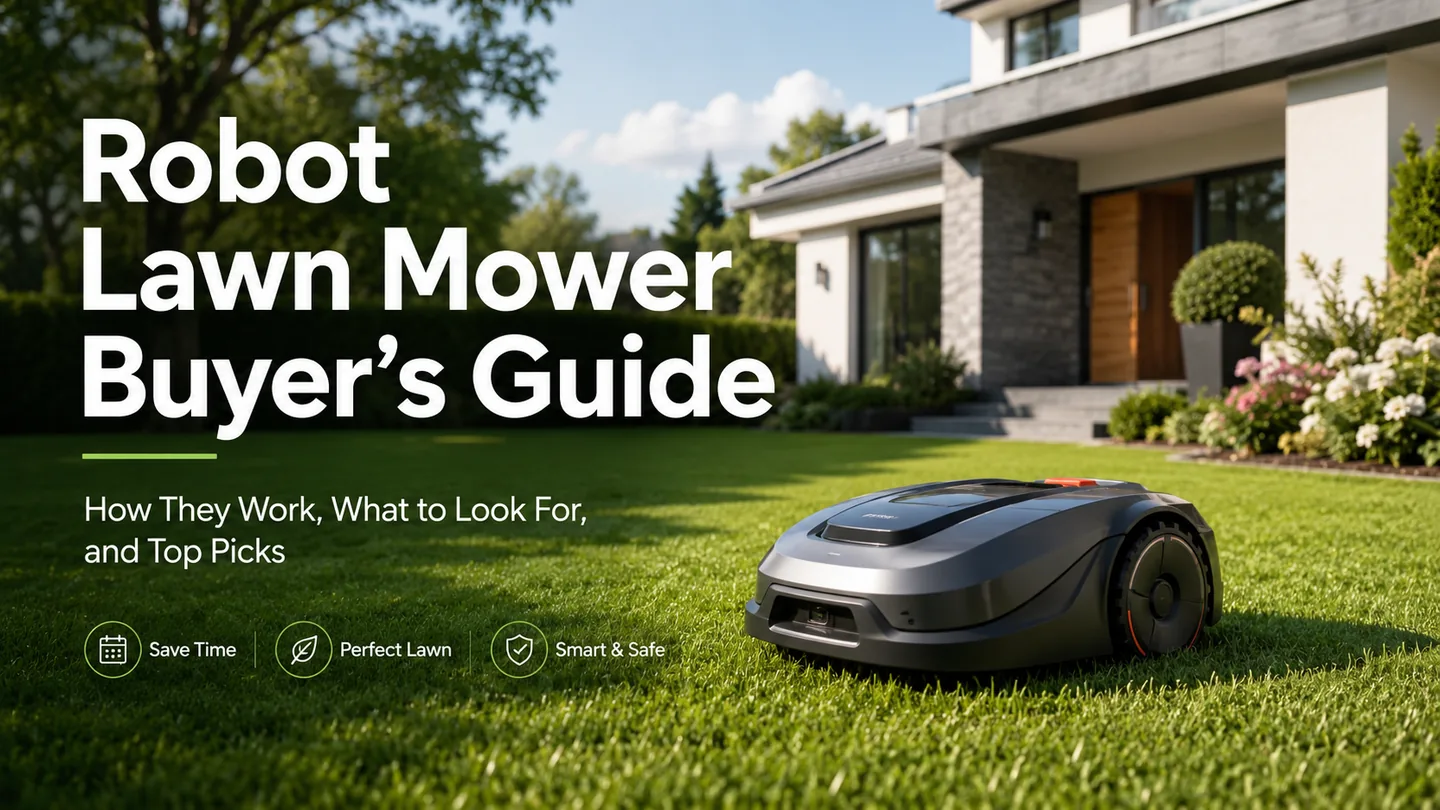
Robot Lawn Mower Buyer’s Guide
A robot mower can take regular mowing off your weekend list, but only if the machine and your yard are a good match.
Comparison at a glance
| Navigation approach | Where it can make sense | What to check first |
|---|---|---|
| Boundary wire | You are comfortable with a physical setup around the mowing area | Installation effort, changes to landscaping, and how repairs would be handled |
| RTK positioning | An open property where the system can establish reliable positioning | The specific setup requirements and how trees, buildings, and yard shape affect the system |
| LiDAR and vision-based navigation | A property with tighter spaces, nearby structures, or complicated boundaries | How the exact mower handles mapping, changing obstacles, and the layout of your lawn |
Are robot lawn mowers actually worth it?
They can be. The appeal is not that a robot mower cuts grass better than every other mower. The appeal is that it cuts a little grass often enough that mowing can mostly disappear from your weekend routine.
That is a real upgrade if your lawn takes an hour every week and you would rather spend that hour doing something else. It is a harder sell for a neat little yard that takes twenty minutes with a regular mower. In that case, I would probably buy a good electric walk-behind mower and keep the extra money.
Robot mowers are not zero-work machines. You still edge, clear sticks and toys, deal with fallen branches, and handle the odd place the mower does not finish cleanly. Think of one as a lawn Roomba with a more serious job and sharper consequences if the yard is full of stuff. The question is whether taking regular mowing off the list is worth the extra cost and setup.
How a robot mower changes the mowing routine
With a walk-behind mower, you wait until the grass needs cutting and then do the whole lawn at once. A robot mower works differently. It goes out on a schedule, takes a small amount off, returns to charge, and goes back out later.
That can keep the lawn at a more consistent height without you setting aside a full mowing block. The catch is that the mower needs enough time and enough capacity for the lawn it is maintaining. Do not buy a machine that is barely sized for the job and expect it to keep up during fast-growing weather.
Start with your yard, not the mower
Before looking at navigation technology, walk the property. Look for separate grass areas, narrow passages, low branches, roots, beds, fencing, playsets, and the places where toys or hoses usually end up.
A clean rectangular lawn is an easy assignment. A yard split between front, side, and back sections with trees and landscaping asks much more from the mower and its mapping system. The better a robot understands your actual layout, the less often you will be out there rescuing it.
Boundary wire, RTK, and LiDAR
The navigation system is one of the biggest differences between robot mowers right now. It decides how much setup you do, how the mower understands its boundaries, and how well it may fit a particular property.
Boundary wire
Boundary wire is the older approach. You place a wire around the mowing area and the mower uses it as a boundary. It can work well, but I would rather avoid putting wire around an entire yard if a wire-free system fits the property and budget. Landscaping changes, damaged wire, and the original installation are all jobs you should count before deciding it is the simple option.
RTK positioning
RTK gives a mower more precise positioning than ordinary consumer GPS. In practical terms, that can let the mower work from mapped areas without a buried boundary wire.
The part that matters is not the acronym. It is whether the setup works reliably where you live. Trees, buildings, rooflines, and the shape of the lawn can all affect a positioning-based system. A wide-open yard and a wooded backyard are different assignments.
LiDAR and vision
LiDAR uses light to map the environment around the mower. Cameras and other sensors can help it understand obstacles and boundaries rather than simply knowing its coordinates.
I would not call LiDAR automatically better than RTK. On an open lawn, RTK may be a very sensible fit. On a property with tighter spaces, nearby structures, or less clear sky, the way a mower maps and sees the environment deserves more attention. The right choice follows the yard, not the technology name on the box.
Hills change the decision
This is where I would slow down before buying. A robot mower that works well on a flat lawn may not be the right machine for a steep, uneven property.
Look at the current manufacturer slope guidance for the exact model. Also pay attention to the drive system, but do not treat a drivetrain label as a safety promise. Wet grass, loose soil, roots, surface changes, and the layout of the hill all matter. If slopes are already a problem with your current mower, read our sloped-yard mower guide before deciding that a robot will solve it.
Edges and obstacles are the real-world test
The middle of a lawn is easy. The edges tell you how much work the robot actually saves.
Think about the lawn beside your fence, the narrow strip by a bed, the tree roots, and the driveway edge. A robot can leave enough trimming behind that you still need a string trimmer every week. That does not make it a bad mower, but it changes the amount of time it really gives back.
Obstacle detection matters for the same reason. Kids, pets, hoses, furniture, toys, sticks, and fallen branches make a family yard different from a product photo. The mower does not need a perfect yard. It needs a setup and sensing system that can handle the yard you actually have.
What size lawn works well?
Do not treat a manufacturer coverage number as a challenge. Buy some breathing room. A robot mower can recharge and keep working, but a machine that is always at its limit can spend so much time mowing that it stops feeling like a convenience.
Small lawns
This is where robot mowers can be easy to fit physically, but the value question is tougher. If you enjoy a quick twenty-minute mow, a regular electric mower is hard to beat. If you want the lawn handled without thinking about it, a compact robot can still make sense.
Around a quarter acre
Navigation, setup, edge behavior, and obstacle handling matter more than chasing the largest possible capacity. A small suburban lawn with trees, beds, and separate zones can be harder than a larger open rectangle.
Around a half acre and beyond
Capacity becomes more important. I would want a mower designed with room to spare for the actual grass area, not one that has to run constantly to stay caught up. At this point, compare the robot against the time you spend with a walk-behind mower and against larger mower categories. Our half-acre mower guide is useful for that side of the decision.
Features worth paying attention to
Mapping and multi-zone support
If the lawn is split into front, side, and backyard sections, make sure the mower can manage that layout. A robot that only works well on one connected patch of grass is a poor fit for a divided property.
Edge cutting
Ask a simple question: how much trimming will this leave for me? The answer matters more than a marketing claim about autonomous mowing.
App and scheduling
The app is part of the mower. You need to be able to set schedules, define mowing areas, create no-go zones, check status, and stop the machine without turning a simple chore into another technology project.
Cutting height
Make sure the mower can maintain the grass height you want. This is especially important if you prefer taller grass or if your lawn gets away from you during a fast-growing stretch.
Robot mower versus a regular electric mower
These are different purchases. A regular electric mower is cheaper, simpler, and gives you complete control over the cut. You take it out, mow the lawn, and put it away.
A robot mower costs more because you are buying time back. If mowing is one of the chores you would happily give away, the case is strong. If you like mowing or only spend a few minutes on it, I would save the money and buy a regular electric mower instead. Our electric versus gas mower guide can help if you are still deciding on a conventional mower.
Final practical takeaway
Buy a robot mower because you want regular mowing off your list, not because the technology is novel. Make sure the navigation setup fits your property, buy enough capacity for the lawn, and be realistic about edges, obstacles, and hills. If the machine can reliably handle those parts, it can be one of the few yard tools that genuinely gives you your weekends back.
Three Robot Mowers for Different Jobs
Smaller-Lawn Robot Example
ECOVACS GOAT O1000 LiDAR PRO Robot Lawn Mower
ECOVACS
Premium
The O1000 fills the smaller-lawn role for someone comparing a LiDAR robot mower against the simplicity and lower cost of mowing a compact yard manually.
Check current price at AmazonLarger-Lawn LiDAR Example
ECOVACS GOAT A3000 LiDAR PRO Robot Lawn Mower
ECOVACS
Premium
The A3000 is the larger-property step up in this three-product comparison. Confirm its current supported area and exact setup requirements against the grass you actually need it to maintain.
Check current price at AmazonAWD Difficult-Terrain Example
Mammotion LUBA 3 AWD 3000H Robot Lawn Mower
Mammotion
Premium
The LUBA 3 AWD 3000H is the example to investigate when hills and difficult terrain are the reason a basic robot mower may not fit. Confirm the exact variant and current terrain guidance; this selection does not assume a garage or other bundle accessory is included.
Check current price at AmazonFrequently asked questions
Can a robot mower replace all lawn work?
Usually not. It can take over regular mowing, but edging, cleanup, fallen branches, and problem spots still need attention.
Do robot mowers need a boundary wire?
Some do and some do not. Many newer systems use positioning, sensors, or mapping instead, but the setup requirements depend on the exact mower.
Are robot mowers good on hills?
Some are designed for more difficult terrain than others. Check the current manufacturer slope guidance for the exact mower and do not assume a robot that works well on flat ground is suitable for a steep or uneven lawn.
Is a robot mower worth it for a small lawn?
It depends on how much you value the time saved. For a lawn that takes only a few minutes to mow, a regular electric mower is often the simpler purchase. The case improves as mowing becomes a regular chore you would rather remove from your schedule.
Related guides
comparison · Comparisons
Electric vs Gas Lawn Mower: Which Should You Buy?
guide · Yard size
What Mower Do You Need for Half an Acre? Start With the Actual Grass
guide · Lawn conditions