Guide · Buying Guides
Why Is My Mower Leaving Strips of Uncut Grass?
Use the location and appearance of missed grass to separate overlap, mowing conditions, blade setup, and problems that need mower service.
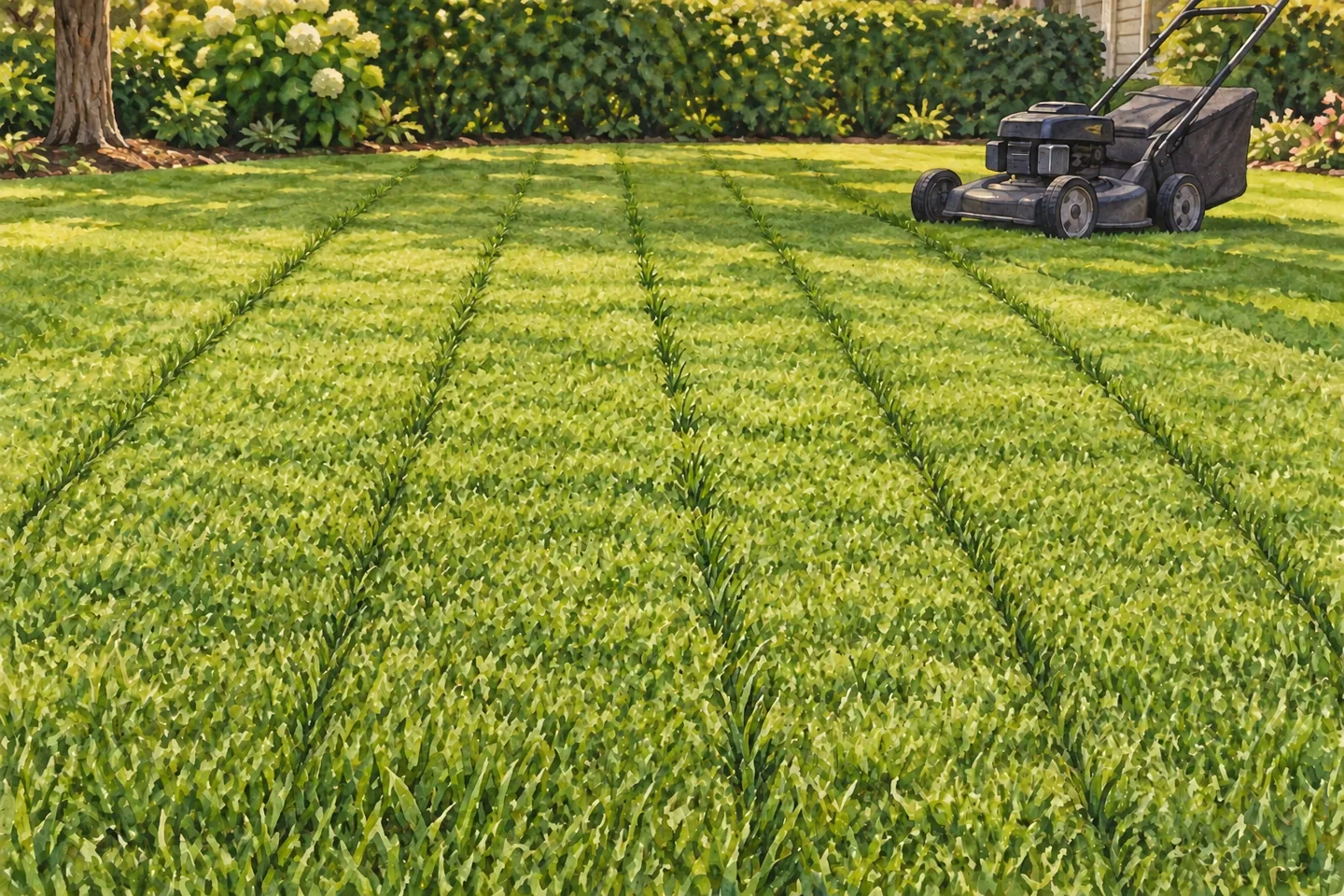
AI-generated illustration: strips of missed grass between mowing passes.
Before buying a different blade, look at where the missed grass is.
A line between neighboring passes gives you a different starting point from a line down the middle of the mower’s path. Random tall blades, clumps of already-cut grass, and alternating light and dark stripes are different observations too.
You’ll waste less time if you describe the result before trying to fix it.
The Short Answer
On suitable dry grass, first check whether a little more overlap or a slower pass changes the result. Check the blade condition, cutting-height setup, and mower configuration according to the manual.
If the same strip remains inside the mower’s path, particularly after blade work or an impact, stop treating it as an overlap problem. Have the blade installation and cutting system checked.
Stop immediately for unusual vibration, a strike, or signs of loose or damaged cutting parts. An extra pass is not a repair.
Is it uncut grass or just a stripe?
With the mower stopped, inspect the lawn from more than one direction. Part the grass and compare its height across the line.
If the height is similar but the apparent light and dark pattern changes as you move, you may be seeing a difference in the way the grass lies. If taller blades stand above the surrounding cut, you have grass the mower missed.
If what you see lifts away as loose clippings, start with collection or mulching performance. That is a different problem from rooted grass left standing.
Use the pattern to choose the next check
| Pattern | First thing I’d investigate | A useful observation |
|---|---|---|
| Narrow line between adjacent passes | Not enough overlap | Does modestly increasing overlap remove it? |
| Scattered tall blades throughout the cut | Conditions, pace, or blade condition | Does a slower pass on comparable dry grass improve the result? |
| Persistent line inside each mower-width pass | Blade setup or the cutting system | Does it stay at the same position within the path? |
| One side consistently higher | Wheel-height settings; on pneumatic tires, correct pressure; then deck setup | Is the difference present on flat ground too? |
| Loose rows or clumps of clippings | Too much material, damp conditions, or the collection setup | Are the rooted grass blades underneath already cut? |
| The problem began just after service | Correct parts and installation | What work changed before the symptom appeared? |
These patterns narrow the investigation. They do not identify a failed component by themselves.
Try one small change at a time
Choose a safe, flat test section with similar grass to the problem area. Keep people and pets clear and follow the mower’s operating instructions.
First try slightly more overlap. If that fixes a line between passes, adjust your route. Next, if needed, try a slower forward pace on a comparable section. Record what changed.
Don’t simultaneously change the height, speed, blade, and battery. You won’t know which change mattered.
Toro includes slower walking, more frequent cutting, appropriate height adjustment, and overlapping swaths among its TimeMaster cut-quality checks. These are sensible first checks for that machine; they do not replace another model’s instructions.
Check the grass you’re asking it to cut
Long, dense growth puts more material through the deck than a light maintenance cut. Wet material can clump and obstruct cutting. Wait for suitable dry conditions rather than treating another pass through wet grass as the answer.
Mow often enough for the amount of growth. University of Minnesota Extension explains the one-third rule and the importance of sharp blades. Choose the final height for your grass species and local conditions.
Look at the cut tips as well as the overall lawn. Ragged, frayed tips are a reason to check blade condition. They are not proof that a mower brand is unsuitable for your yard.
Check setup before changing parts
Before inspection, stop the mower, wait for moving parts to stop, and isolate the power exactly as the manual requires. That may include battery and key removal or disconnecting the spark-plug lead. Use the specified access and support method; don’t reach beneath an unsecured mower.
Check the accessible items the manual identifies: cutting-height settings, the correct mulching or bagging configuration, and maintenance condition. For pneumatic tires, use the specified pressures; don’t copy a pressure from a different mower.
Cub Cadet’s uneven-cut guidance identifies tire pressure and cutting-component condition among the things to investigate on riding equipment. Deck leveling and mechanical repairs need the model-specific procedure.
If it started after changing a blade
Check the replacement part number and installation against the manual. “It fits the bolt” does not establish that it is the correct blade.
Multi-blade systems can require a particular blade combination, orientation, hardware, and fastening procedure. The EGO LM2130/LM2150SP family manual, for example, lists incorrect blade assembly as a possible cause of uneven cutting.
If you can’t confirm the setup, have it checked before continuing. Don’t substitute a generic torque setting or try to reshape a blade to change the cutting path.
When to go back to the dealer or manufacturer
If a new or recently serviced mower keeps missing the same strip after the basic checks, document it while the service history is clear.
Take a photo of the missed grass, note whether it sits between passes or inside one pass, and record the model, blade or service change, height setting, and conditions. Include any unusual sound, vibration, or displayed fault.
That gives the shop a specific symptom to reproduce. It is much more useful than replacing several parts because different people online suggested them.
Why we wrote this: a riding-mower owner asking about a center strip and an owner reporting missed grass with a new EGO illustrate the need to separate symptoms. This guide uses manufacturer and extension sources for the checks; it does not diagnose those owners’ machines or claim hands-on testing.
Related guides

guide · Buying Guides
What Size Lawn Mower Do I Need? Measure the Lawn, Then Compare the Time
guide · Buying Guides