Comparison · Chainsaws
STIHL vs. ECHO Chainsaws: Which One Would I Buy?
Compare STIHL and ECHO chainsaws for homeowner cleanup, firewood, heavier property work, dealer support, saw size, and long-term ownership.
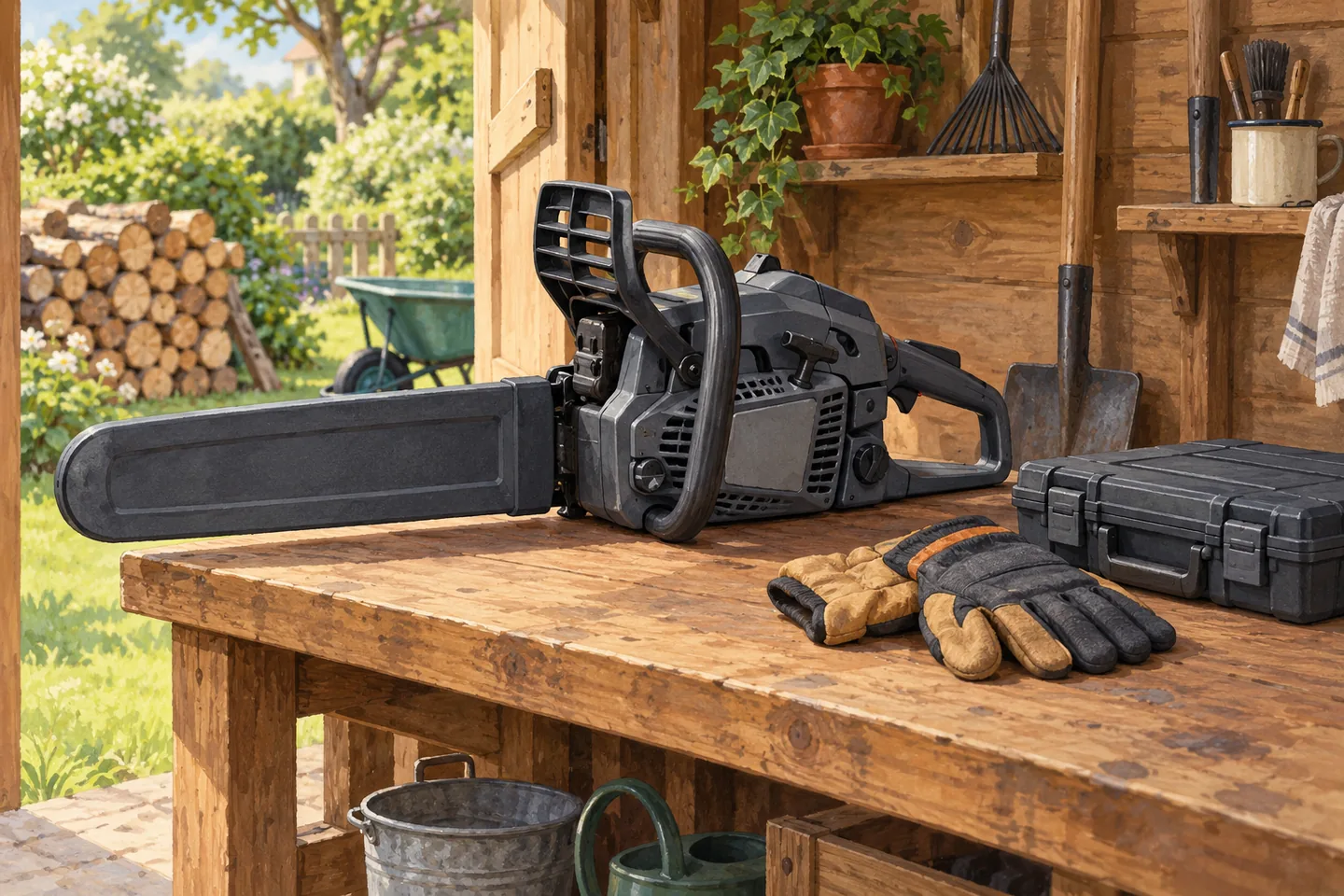
AI-generated illustration: parts, maintenance, and service support are part of chainsaw ownership.
STIHL and ECHO both make good chainsaws.
That doesn’t make choosing between them particularly easy.
If I were buying one, I wouldn’t start by trying to decide which brand is “better.” I’d start with what I’m actually going to cut and what kind of support I have nearby.
A saw that comes out twice a year for storm cleanup is a different purchase from one that’s going to cut firewood every weekend.
And once you get into gas chainsaws, the dealer matters too.
The Short Answer
If both brands had equally good local support, I wouldn’t choose based on the logo.
I’d choose the saw size that fits the work.
For lighter homeowner cleanup, both companies have smaller saws that make more sense than dragging around a big Farm Boss or Timber Wolf.
For regular firewood and property work, both have good mid-size options.
Once the work gets heavier, ECHO’s CS-590 is worth looking at because you’re getting a 59.8cc saw without moving into a completely different professional category.
STIHL gets the edge for me when there’s a good local STIHL dealer nearby.
Chainsaws, like most lawn equipment, need support. Chains dull out. Bars wear down. Small engines need to be maintained, and eventually something is going to need service.
If somebody ten minutes away knows the saw and stocks the parts, I care about that.
Start With What You’re Actually Cutting
This matters more than the brand.
Think about the jobs you expect the saw to handle most often.
Maybe it’s:
- branches after storms
- cutting up a fallen tree
- pruning larger limbs
- occasional firewood
- regular firewood
- clearing property
- dropping larger trees
Don’t size the saw around the biggest thing you can imagine cutting once.
Size it around the work you’ll actually do. Our chainsaw sizing guide goes deeper into that decision.
A smaller saw is lighter.
That matters when you’ve been holding it for an hour.
A larger saw gives you more power and lets you comfortably run a longer bar, but you’re carrying that extra engine around every time you use it.
There isn’t much benefit in owning more saw than you need.
Lighter Homeowner Work: STIHL MS 172 vs. ECHO CS-3510
If I mostly needed a saw for storm cleanup, fallen branches, and occasional cutting around the property, I’d start here.
The STIHL MS 172 is an entry-level homeowner gas saw.
It’s roughly a 31cc-class saw, makes about 1.9 hp, and the powerhead weighs about 10.4 pounds without the bar and chain.
The ECHO CS-3510 is 34.4cc and considerably lighter on paper at about 8.2 pounds dry without the bar and chain.
ECHO supports 14- and 16-inch bars on the CS-3510.
This is the size class I’d rather own if most of my chainsaw use is cleanup.
You’re not carrying around a large engine for no reason.
If I were comparing these two, I’d care about:
- how each one feels in my hands
- weight
- starting
- dealer support
- parts availability
- what bar length I actually need
I wouldn’t obsess over the small displacement difference.
For occasional homeowner cutting, I’d rather have the saw I don’t mind picking up.
Regular Property Work: STIHL MS 250 vs. ECHO CS-4510
This is a more interesting comparison if you’re actually cutting firewood or doing regular property cleanup.
The STIHL MS 250 is 45.4cc, makes about 2.9 hp, and weighs about 10.1 pounds without the cutting attachment.
The ECHO CS-4510 is right in the same engine-size neighborhood at 45cc and weighs about 11 pounds dry.
ECHO lists 16-, 18-, and 20-inch guide-bar options for the CS-4510.
This is the class I’d probably start with for somebody who owns some property and knows the chainsaw is going to get used.
There’s enough saw here for much more than trimming branches, without immediately jumping into a big heavy machine.
If both dealers were equally close, I’d compare these saws directly instead of deciding that STIHL or ECHO automatically wins.
The numbers are close enough that I’d care more about:
- how the saw feels
- local service
- starting behavior
- what bar setup I want
- replacement parts
- what I’m actually paying
This is also why I don’t like buying chainsaws entirely from a specification table.
You’re going to hold the thing.
Weight and balance matter.
Heavier Work: STIHL MS 271 vs. ECHO CS-590
These two get compared a lot, but they aren’t actually the same size saw.
The STIHL MS 271 Farm Boss is 50.2cc, makes about 3.5 hp, and weighs about 12.4 pounds without the bar and chain.
The ECHO CS-590 Timber Wolf is 59.8cc and weighs about 13.2 pounds dry.
ECHO commonly sells the CS-590 with a 20-inch bar and supports other bar lengths depending on configuration.
So don’t look at the names and assume these are direct equivalents.
The ECHO is bringing a noticeably larger engine.
If I were regularly cutting a lot of firewood or working through larger wood, that would get my attention.
If the saw was mostly property maintenance with some firewood mixed in, I might prefer carrying less saw around.
Again, it comes back to the work.
You don’t need a 60cc saw because one tree fell during a storm.
But if you’re processing several cords of firewood every year, buying a bigger saw starts making a lot more sense.
| Model | Engine class | Weight | Typical role |
|---|---|---|---|
| STIHL MS 172 | ~31cc | 10.4 lb | Light homeowner work |
| ECHO CS-3510 | 34.4cc | 8.2 lb | Light homeowner work |
| STIHL MS 250 | 45.4cc | 10.1 lb | Property / firewood |
| ECHO CS-4510 | 45cc | ~11 lb | Property / firewood |
| STIHL MS 271 | 50.2cc | 12.4 lb | Heavier property work |
| ECHO CS-590 | 59.8cc | 13.2 lb | Larger firewood work |
Manufacturer weight definitions are not necessarily identical, so I wouldn’t treat these as laboratory-equivalent measurements.
Dealer Support Matters
Chainsaws, like most lawn equipment, need support.
Chains dull out. Bars wear down. Small engines need to be maintained, and eventually something is going to need service.
That gives STIHL the edge if you have a good dealer nearby.
STIHL leans heavily on its dealer network. Before buying one, I’d check what’s actually close to you and whether that dealer services saws in-house.
ECHO also has a large independent dealer network.
I’d check that too.
If I had a good STIHL dealer ten minutes away and the closest ECHO service shop was 45 minutes away, that would affect what I bought.
The opposite would be true too.
For equipment you might keep for ten or fifteen years, having somewhere nearby that can actually support it matters.
Buying From a Dealer Isn’t a Bad Thing
I buy plenty of equipment online.
Chainsaws are one category where I don’t mind buying through a dealer.
You’re buying something with:
- a two-stroke engine
- a bar
- a chain
- a clutch
- an oiler
- fuel-system parts
- wear items
Things eventually need attention.
A good dealer can also help make sure you’re buying the right bar, chain, files, and replacement parts instead of trying to decode chain pitch and gauge in the aisle five years later.
That doesn’t mean you need somebody holding your hand every time the chain gets dull.
Basic chainsaw maintenance is part of owning one.
But I like knowing I have somewhere to take it if a problem moves beyond basic maintenance.
Parts Matter More Than People Think
The chainsaw itself is only part of what you’re buying.
Eventually you’ll need:
- chains
- bar oil
- air filters
- spark plugs
- files or sharpening equipment
- maybe another guide bar
- replacement parts
Common saws from major brands make this easier.
That’s another reason I’d rather own a mainstream STIHL, ECHO, or Husqvarna than save a little money on a gas saw from a brand I’m not confident will still have parts available years from now.
You can keep a good chainsaw for a long time.
Parts availability becomes more important the longer you own it.
Don’t Buy a Huge Saw Because of One Storm
I understand the temptation.
A tree comes down.
You spend half a day fighting it with a little saw.
Now you want the biggest chainsaw you can find.
I still wouldn’t size the next saw around one bad Saturday.
If most of the year you’re cutting branches and smaller logs, a lighter saw is going to be nicer almost every time you use it.
If you’re actually cutting large logs regularly, that’s different.
Buy the bigger saw.
But there is a point where more engine and more bar just means more weight you’re carrying around.
Bar Length Isn’t the Same Thing as Saw Size
This is another thing I’d watch when comparing chainsaws.
A longer bar doesn’t automatically make two saws equivalent.
The engine has to pull that chain through the wood.
I’d rather have an appropriately sized engine and bar combination than buy a small saw because somebody managed to put a long bar on the listing.
Look at:
- engine displacement
- manufacturer-supported bar lengths
- the type of wood you’re cutting
- how often you’ll be making large cuts
The biggest available bar isn’t necessarily the one I’d use every day.
Starting Matters
A gas chainsaw that starts reliably feels a lot better than one that wins a specification comparison and makes you fight it every time it has been sitting for a month.
Both STIHL and ECHO have their own starting systems and procedures.
Whatever you buy, learn the procedure for that exact saw.
Fresh fuel matters too.
Gas chainsaws don’t particularly like sitting around with old fuel and then being expected to start perfectly six months later.
If you’re an occasional user, storage and fuel maintenance are part of the ownership decision.
What I’d Buy
If I were doing light homeowner cleanup, I’d stay in the smaller class.
Something around the MS 172 or CS-3510 makes more sense to me than immediately buying a Farm Boss.
If I were regularly cutting firewood and maintaining a larger property, I’d move toward the MS 250 / CS-4510 class.
If I were processing a lot of firewood or regularly cutting larger material, I’d start looking harder at the MS 271 and CS-590.
Between STIHL and ECHO themselves, local support could break the tie for me.
If there’s a good STIHL dealer close by, that gives STIHL the edge.
If ECHO has better support where I live, I’d be perfectly comfortable going the other direction.
I’d rather buy the saw that fits the work and that I can keep running than worry too much about which badge is on the side.
The Brand Matters Less Than Buying the Right Saw
STIHL, ECHO, and Husqvarna all make saws I’d be comfortable owning.
I’d start with the work.
Then I’d look at the saw size.
Then I’d look at dealer support.
For STIHL vs. ECHO specifically, I don’t think there’s a universal winner.
If you have a strong STIHL dealer nearby, that gives STIHL the edge.
If ECHO support is better where you live or the particular ECHO saw fits your work better, buy the ECHO.
The mistake I’d avoid is buying far more chainsaw than you need because the bigger model sounds better on paper.
You’ll notice the weight every time you use it.
Other brands to compare
If you also want to shop outside STIHL and ECHO, the two Husqvarna listings below are separate alternatives to investigate. They are not winners of the comparison above. Check the exact configuration, seller and local service before choosing one.
For another researched option, read our Husqvarna 455 Rancher review. The 455 is a different model from the 450 Rancher listing below.
Affiliate disclosure: As an Amazon Associate, this site earns from qualifying purchases.
Husqvarna listings
Another brand: 18-inch listing
Husqvarna 440 Gas Chainsaw — 18"
Husqvarna
A separate Husqvarna option to compare after considering the STIHL and ECHO models above. Verify the selected configuration and local service.
Check current price at AmazonAnother brand: 20-inch listing
Husqvarna 450 Rancher Gas Chainsaw — 20"
Husqvarna
A separate 450 Rancher listing to investigate. This is not the 455 Rancher reviewed elsewhere on the site.
Check current price at Amazon