Comparison · Leaf blowers
Backpack vs. Handheld Leaf Blower: Compare the Whole Cleanup Job
Compare handheld and backpack blowers by working weight, runtime, carrying comfort, noise measurements and the leaf cleanup you actually do.
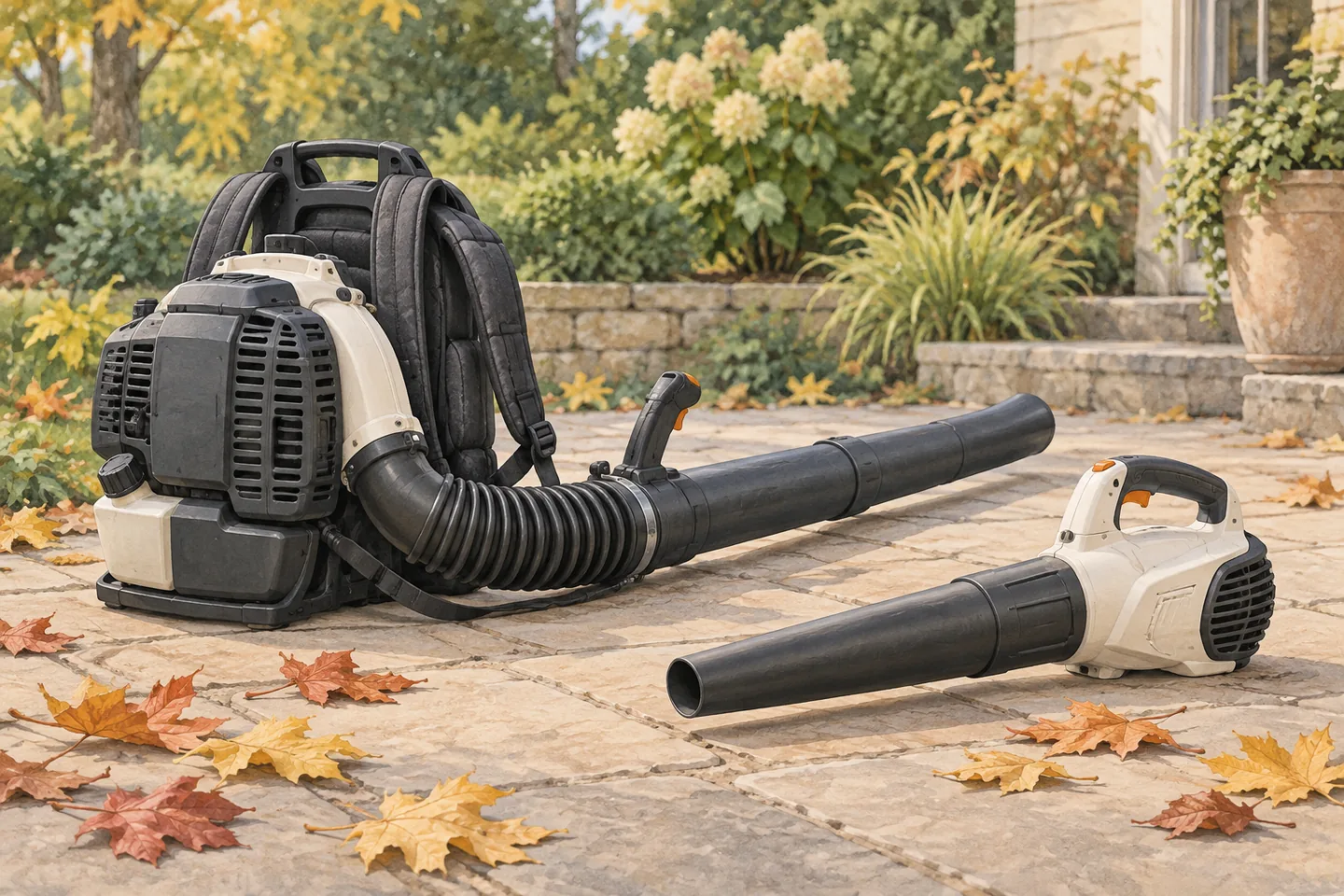
AI-generated illustration: backpack and handheld blowers carry their weight differently.
A backpack blower moves the machine’s weight onto your back. It does not make the machine weightless, and it does not automatically mean more useful clearing power than every handheld model. The right choice depends on the route, the time spent blowing and what happens to the leaves afterward.
Separate two decisions: how you want to carry the tool and how you want to power it. Handheld does not always mean battery, and backpack does not always mean gas.
The Short Answer
I would start with handheld for short, scattered jobs around a house: a patio, driveway, paths and small leaf collections. I would investigate a backpack when you spend long stretches actively blowing and holding a handheld has become uncomfortable.
Before upgrading, check what is taking the time. If most of the work is bagging or hauling a heavy pile, a bigger blower may barely change the finished job. Improve collection first when collection is the bottleneck.
Compare the complete working setup
| Question | Handheld | Backpack |
|---|---|---|
| Short, frequent jobs | Usually convenient to pick up and put away | Harness setup can be unnecessary for a brief task |
| Extended active blowing | Weight and airflow reaction are carried through the hand and arm | Harness distributes machine weight, but fit and total load still matter |
| Repeated bagging or moving obstacles | Easier to set down between tasks | Repeatedly taking the machine off can interrupt the route |
| Storage and transport | Often simpler in a crowded shed or vehicle | Needs room for the frame, harness and tube |
| Power source | Corded, cordless and gas options exist | Gas and battery options exist; compare exact packages |
That last row matters. A comparison between one battery handheld and one gas backpack cannot prove which carrying style is inherently quieter or cheaper to maintain.
Two examples show why headline numbers need context
The EGO LB7654 is a battery handheld kit with a 5Ah battery. EGO advertises up to 765 CFM in turbo mode, but its detailed runtime specification gives fifteen minutes in turbo with that battery. The longer average-runtime headline is not a promise of ninety minutes at maximum output. EGO LB7654 specifications.
The current U.S. Husqvarna 150BT is a gas backpack. Its specification page lists 21.95 pounds and 22 newtons of maximum blowing force. These are different measurements from air volume, and the weight entry alone should not be presented as a verified full-fuel operating weight. Husqvarna 150BT specifications.
There is another reason to read the detailed tables: Husqvarna’s page has a 765-CFM marketing headline but lists about 452 CFM at the round nozzle. I would not treat the headline as a directly comparable nozzle measurement against another blower without matching the conditions.
Our EGO LB7654 review and Husqvarna 150BT review discuss those specific purchases. Neither is the automatic winner for every yard.
Bare-tool weight can make a handheld look lighter than it is
EGO’s LB7650 manual lists 4.6 pounds without a battery. Its BA2800T 5Ah battery page lists another 4.9 pounds. Adding those published component figures gives about 9.5 pounds; this is a calculation, not our measurement of an assembled blower. EGO blower manual, battery specification.
The point is to include the power supply when evaluating comfort. A large battery can make a handheld harder to carry even when it extends runtime. A backpack can distribute a heavier load, but the tube still needs directing and the harness needs to fit.
Try the actual configuration, powered off, where a retailer permits it. Do not choose from an empty display tool or assume padding compensates for a poor fit. If comfort is already a concern, compare manageable equipment and shorter sessions rather than simply buying the biggest unit.
Compare noise figures only when they measure the same thing
An operator-ear sound-pressure measurement is not interchangeable with a measurement taken far away, or with a sound-power rating. A single dB figure without that context cannot tell you which blower will be quieter for you or your neighbors.
Husqvarna’s 150BT page distinguishes operator-ear sound pressure from sound power. Keep those labels attached to the numbers when shopping. Do not turn unmatched figures into a percentage claim about how much quieter another tool is.
Follow the tool’s hearing-protection requirements and check your local permitted hours and equipment restrictions. A quieter-sounding motor does not remove the need to use the tool responsibly.
Time the job you want to improve
Here is a hypothetical thirty-minute cleanup: ten minutes of blowing, fifteen minutes of gathering and hauling, and five minutes moving furniture and putting tools away. Even cutting the blowing time in half would save only five minutes overall. That is arithmetic, not a product test.
Now consider a route dominated by sustained blowing. Carrying comfort and enough energy or fuel for the session become more important. That is the situation where a backpack deserves a serious look.
Wet leaves can change either route. A rake, tarp or collection method may help more than repeatedly blasting the same heavy pile. See our wet-leaf guide and large-volume leaf cleanup plan.
What I would buy
For brief cleanup, I would keep the purchase simple and start with a manageable handheld. For extended active blowing, I would compare a properly fitted backpack against a handheld with an appropriate battery and any manufacturer-approved carrying support.
For either, total the price of the complete setup and the routine needed to keep it ready. The better blower should shorten or simplify the job you actually repeat—not just look more capable hanging in the shed.
Research checked September 7, 2026. This is a researched buying guide, not our own hands-on test.
Related guides

guide · Leaf blowers