Guide · Owner favorites
Why Owners Keep Their Honda Mowers—and What to Know Before Buying One Today
Why older Honda gas mowers inspire loyalty, what their engine reputation means, and how to judge the newer HRX-BE battery mower as a long-term purchase.
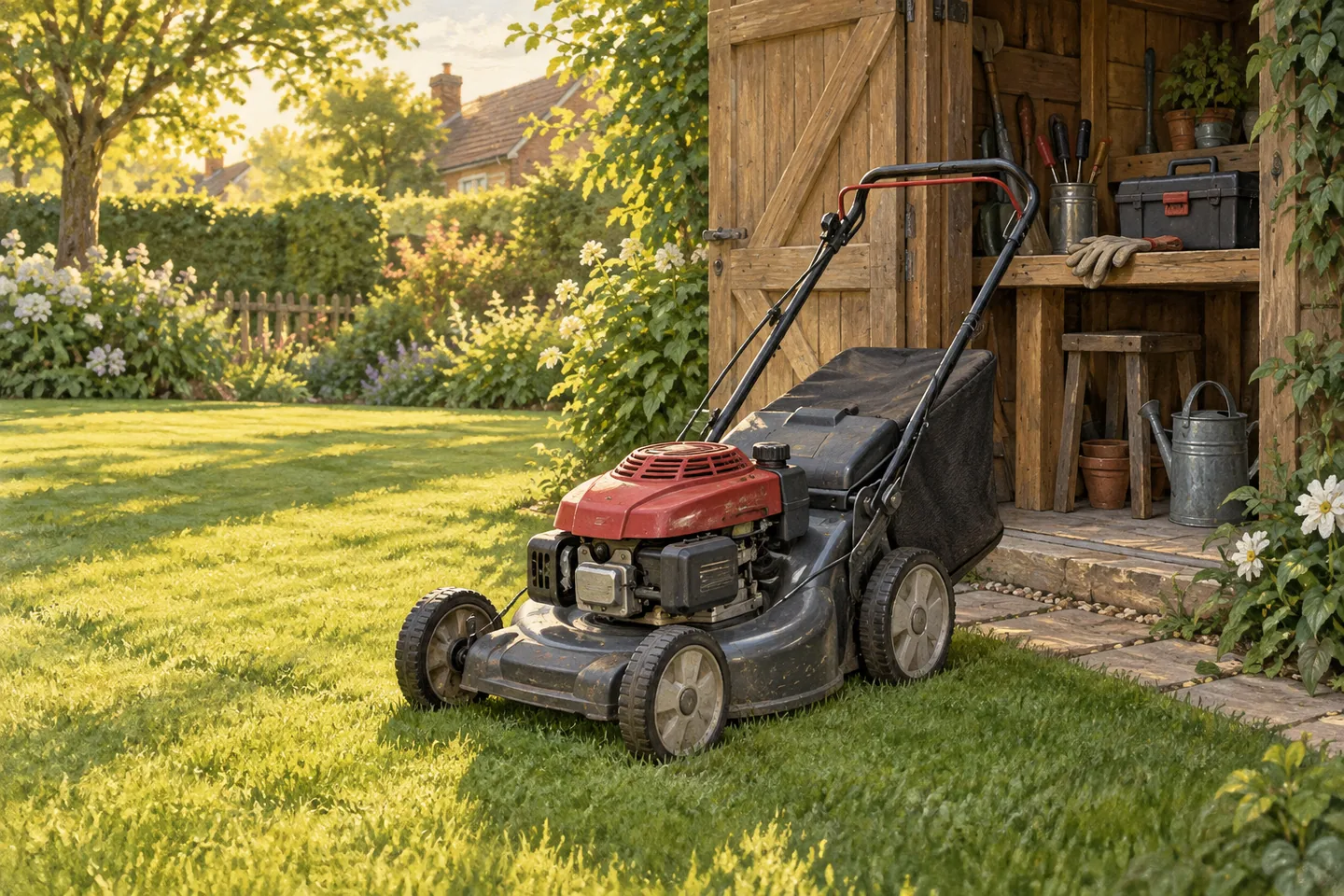
AI-generated illustration of an older gas mower; not the HRX-BE battery model.
A mower gets expensive when you keep replacing it. Buying something you can maintain, repair, and keep using is a reasonable goal. You want to cut the grass and put it away. You don’t want to shop for another mower every few summers.
Honda comes up repeatedly in that conversation. But before buying one today, check which Honda you’re looking at. An older gas HRX and the newer battery HRX-BE share a name. They don’t share an engine.
The Short Answer
Honda’s older gas walk-behinds have an enthusiastic following among owners who value easy starting and years of ordinary use. That makes Honda worth considering when you want a mower to keep. It doesn’t establish a lifespan for every model.
The Honda HRX-BE featured here is battery-powered. I’d consider it for a long-term purchase if the mowing time, replacement-battery cost, and local service options fit. I would not buy it expecting the old gas engine underneath the cover, or assume that stories about a decades-old Honda prove how long its battery system will last.
Honda HRX-BE — the current battery model
The current battery model
Honda HRX-BE
Model HRX217YXBEXA6. This is the battery mower discussed below; the gas-engine history explains Honda's following, not this model's power source.
Check current price at AmazonWhat owners actually seem to love
In the owner discussion that prompted this article, Honda praise centers on familiar things: dependable starting, keeping the same machine for years, and being reluctant to replace a mower that still works. Owners mention several models, including HRN and HRX gas mowers. One also describes long service from a different mower brand fitted with a Honda engine.
The discussion includes satisfied Toro owners and recommendations for other equipment too. It isn’t a vote that establishes one universally loved mower, and individual ownership stories aren’t verified durability tests.
What I take from it is a useful buying priority: look past the first season. How does the mower hold up as something you own, maintain, and occasionally need to fix?
Where Honda’s engine reputation comes from
Honda’s gas mower range used several engines. The older HRX217VKA, for example, has a GCV200 engine and an automatic choke, according to Honda’s model documentation. That combination helps explain why starting behavior features so heavily in discussions about these machines.
Engine names matter here. Honda lists the GCV160/190 family for residential applications and the GXV160 for commercial use on its lawn-mower engine page. A Honda badge doesn’t make every engine, transmission, and mower around it the same equipment.
The engine also isn’t the whole mower. A machine can start well and still be unpleasant to push, expensive to repair, or a poor fit for your lawn. When comparing used machines, I’d want to know about the drive system and deck condition along with the engine.
There is a practical reason to care about support. Honda provides engine service and repair materials. Before buying an older mower, ask a servicing shop about the exact model and the repair you’re likely to need. The existence of a manual doesn’t guarantee every old part will be available at a price you like.
Buy it once still means maintain it
Blades dull. Wheels wear. Small engines need maintenance.
Honda’s gas-mower fuel guidance addresses deteriorating fuel, air-filter care, and storage. Its maintenance resources cover oil changes, spark plugs, blades, and other routine work. Follow the manual for the particular mower rather than borrowing a maintenance interval from somebody else’s machine.
A story about a mower surviving neglected maintenance is interesting. It isn’t a maintenance plan.
If buying a used gas Honda, check the model and serial number against Honda’s recalls and updates, and ask for confirmation that any applicable repair was completed. Honda lists a 2023 decompressor-system recall affecting specified mower serial ranges. Long-term ownership should include checking those records.
What you get with the HRX-BE
The Amazon model linked above is HRX217YXBEXA6. Its listing identifies a battery-powered mower with a 12Ah battery.
Honda’s HRX-BE specifications describe the following setup:
| Item | Honda’s listed specification |
|---|---|
| Cutting width | 21 inches |
| Motor | Brushless electric |
| Deck | NeXite composite |
| Cutting system | MicroCut twin blades; Versamow mulching and collection adjustment |
| Drive | Variable-speed rear-wheel self-propelled drive |
| Included battery | One 12Ah pack; second bay available |
| Claimed runtime | Up to 45 minutes on the included pack |
| Included charger | Approximately six hours to charge |
| Residential warranty | Five years for the mower; three for the battery |
The second bay matters if you need more runtime, but a second pack is an additional purchase. Honda’s longer 90-minute claim uses two 12Ah batteries. Conditions affect the result. Warranty terms and exclusions still apply.
Honda announced November 2025 availability for this battery mower range. As of September 2026, it simply cannot have the same decades-long ownership record as the gas machines people describe.
How I’d decide whether to keep it on the shortlist
Start with your actual mowing routine. A battery specification is useful only when you compare it with the work you need done.
If you’re usually cutting for an hour, don’t plan the purchase around a shorter advertised runtime and hope your lawn is unusually easy. Price enough approved battery capacity from the start. Our battery-runtime guide explains how to measure the shortage without confusing it with a mower fault.
Next, ask a local shop three questions: do you service this exact model, what does a replacement battery cost today, and how are motor or drive repairs handled after the warranty? Those answers are more useful than a vague assurance that Honda lasts forever.
Finally, compare the complete ownership cost. As a hypothetical example, a $1,000 mower kept for ten years starts at $100 per year. A $400 mower replaced every four years has the same purchase cost per year. Neither figure includes maintenance, repairs, batteries, energy, or resale value. These are arithmetic examples, not predicted lifespans or current prices.
Paying more can make sense for a mower you prefer using and can keep repairing. The higher price alone doesn’t make it the cheaper purchase.
Would I feature it?
Yes. Honda is worth a feature about owner loyalty and buying equipment you intend to keep. The older gas machines give that story substance. The current battery model gives shoppers a different purchase to evaluate.
For the HRX-BE, my recommendation would stay conditional: confirm the full battery cost, try the controls, and check service support. Then decide whether it fits your lawn better than the alternatives.
That’s the version of buy it once I find useful: choose carefully, maintain what you buy, and repair it when doing so makes sense. Nobody can promise that you’ll never need another mower.
Research checked September 5, 2026. This is a researched buying guide, not a hands-on mower test. Owner comments are paraphrased; no commenter quotations are used.
Related guides
guide · Buying Guides