Guide · Buying Guides
40V vs. 56V vs. 80V: What Battery Numbers Actually Tell You
Understand volts, amp-hours and watt-hours with worked examples, then compare lawn-tool batteries without mistaking a voltage label for performance.
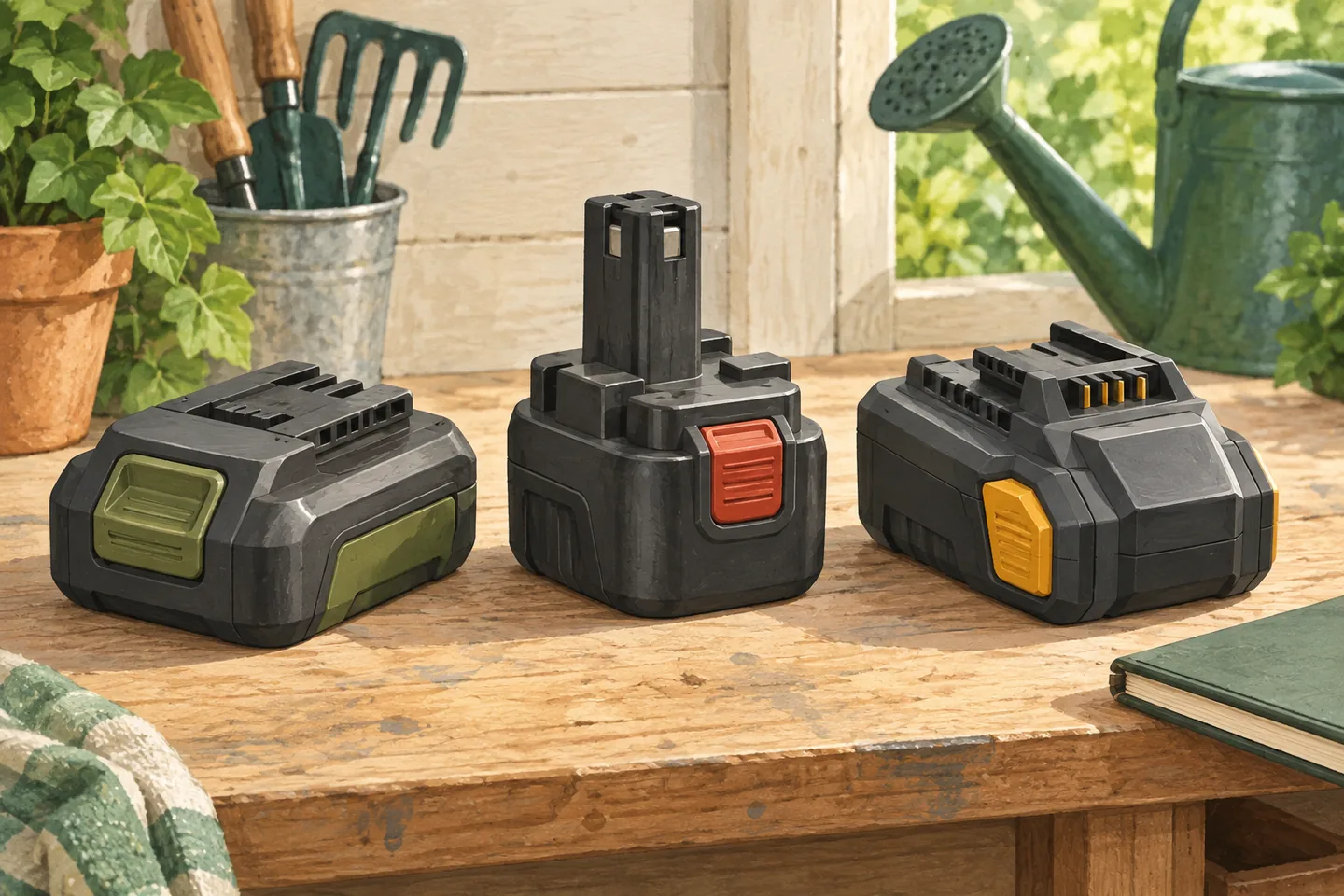
AI-generated illustration: different battery platforms use different connections; check compatibility for the exact tool.
An 80V label does not prove that a mower cuts better than a 56V mower. A 6Ah battery does not necessarily hold more energy than a 4Ah battery on a different platform. Those numbers describe different things, and the way they are labeled matters.
You do not need to become an electrical engineer to shop intelligently. You need to keep voltage, stored energy and working performance separate.
The Short Answer
Use voltage to help identify the intended electrical platform, not to rank unrelated tools. Use watt-hours to compare rated battery energy where the figures are reported on a comparable basis. Use exact-model specifications and relevant testing to judge what the complete tool can do.
Amp-hours are most useful for comparing batteries within the same voltage system. A higher-voltage battery is not a substitute for the battery your tool requires, even if an adapter or similar-looking connector seems to make it fit.
Three numbers that answer different questions
| Number | What it describes | What it does not establish |
|---|---|---|
| Volts, V | Electrical potential; one characteristic of a battery system | Cutting quality, runtime or compatibility by itself |
| Amp-hours, Ah | Rated charge capacity | Comparable stored energy across different voltages |
| Watt-hours, Wh | Rated energy capacity | Guaranteed working time under every load |
Power, measured in watts, is different again: it describes the rate of energy use or delivery. A tool using energy faster can finish a task sooner, empty a battery sooner, or both. The design and the job decide which result you get.
Watt-hours make the energy comparison clearer
For a simple rated-energy estimate, multiply nominal volts × amp-hours. Prefer the manufacturer’s stated Wh rating when available, and use consistent voltage definitions.
These are hypothetical battery examples, not specifications for the brands in this article’s title:
| Battery | Nominal voltage | Capacity | Calculated rated energy |
|---|---|---|---|
| A | 36V | 2Ah | 72Wh |
| B | 36V | 4Ah | 144Wh |
| C | 72V | 2Ah | 144Wh |
B and C have the same calculated energy even though C has twice the voltage and half the amp-hour rating. That does not make them interchangeable, and it does not prove that the tools using them perform equally.
A battery’s usable delivered energy also depends on its condition, temperature, discharge rate and the tool’s control limits. The table is a comparison of ratings, not a promise that every listed watt-hour reaches the cutting attachment.
Maximum and nominal voltage are not the same label
Battery voltage changes during use. Manufacturers may advertise a maximum initial value or use a nominal rating, so the large number printed on one system should not automatically be compared with another on an identical basis.
DEWALT, for example, distinguishes 20V MAX from 18V nominal and 60V MAX from 54V nominal in its platform documentation. That explains why dividing or multiplying the large labels without reading the definitions can mislead. DEWALT voltage definitions.
Do not invent a nominal voltage for another brand from this example. Use that battery’s own documentation. If two manufacturers report energy using different conventions, keep the convention visible instead of presenting the resulting numbers as a laboratory-equivalent comparison.
Energy is not the same as runtime
Suppose a hypothetical 144Wh battery supplies a tool drawing a constant 300W. The ideal calculation is 144 ÷ 300 = 0.48 hours, or 28.8 minutes. At a constant 600W, the same calculation gives 14.4 minutes.
Those are arithmetic examples with a constant load and the full rated energy assumed usable. Real yard tools vary their load and do not necessarily deliver that result. Thick grass, a dull cutting edge, turbo mode or a different attachment can change energy demand.
This is why a blower’s low-setting runtime should not be paired with its maximum-airflow claim as though both happen simultaneously. For a documented example, EGO lists fifteen minutes in turbo with a 5Ah battery for its LB7650-family blower, alongside longer runtime figures under other conditions. EGO’s mode-specific specifications.
Two batteries do not always mean twice the runtime
The tool determines how its batteries are used. Some tools need two packs together. Others use packs in another arrangement, or use one while carrying a spare. Count the required operating configuration, not simply the batteries pictured in a kit.
For a hypothetical pair of 18V nominal, 5Ah batteries used in series, the combined rating is 36V, 5Ah: 180Wh total. It is not 36V, 10Ah. Each individual pack stores a calculated 90Wh, and the pair stores their combined 180Wh.
Makita’s LXT range includes tools designed around two 18V packs. That is an example of a documented tool architecture, not a suggestion to connect batteries yourself. Makita LXT system.
Matching voltage does not guarantee compatibility
The connector, electronics, protection system and manufacturer-approved combination matter. Two different brands can use similar voltage labels and still have incompatible batteries. Even one brand can sell several separate systems.
Greenworks, for example, states that its battery families are interchangeable within the same voltage platform, not universally across its 40V, 60V and 80V ranges. Greenworks compatibility guidance.
Check the exact tool and battery model. Do not rely on color, shape or a marketplace adapter listing to decide that the combination is appropriate.
How I would use the numbers while shopping
First, choose tools that fit the job. Next, check the battery and charger actually included in each offer. Record the stated energy, the measurement convention and any minimum or recommended battery requirement. Finally, compare runtime evidence only when the work and settings are reasonably comparable.
For an existing mower that stops before the job is finished, our battery-runtime troubleshooting guide is more useful than simply chasing a larger voltage label. For a new set of tools, use the battery-platform buying guide to compare the complete purchase.
The electrical numbers help you ask better questions. They do not remove the need to compare the actual mower, trimmer or blower.
Research checked September 7, 2026. This is a researched buying guide, not our own hands-on test.
Related guides
guide · Buying Guides
Best Battery Lawn Tool System: Compare Five Platforms Before Buying

guide · String trimmers