Guide · Pole saws
How to Choose a Pole Saw: Reach, Weight, and Three Options
Compare manual and cordless pole saws, understand advertised reach, and decide whether a DEWALT or EGO kit fits your routine pruning.
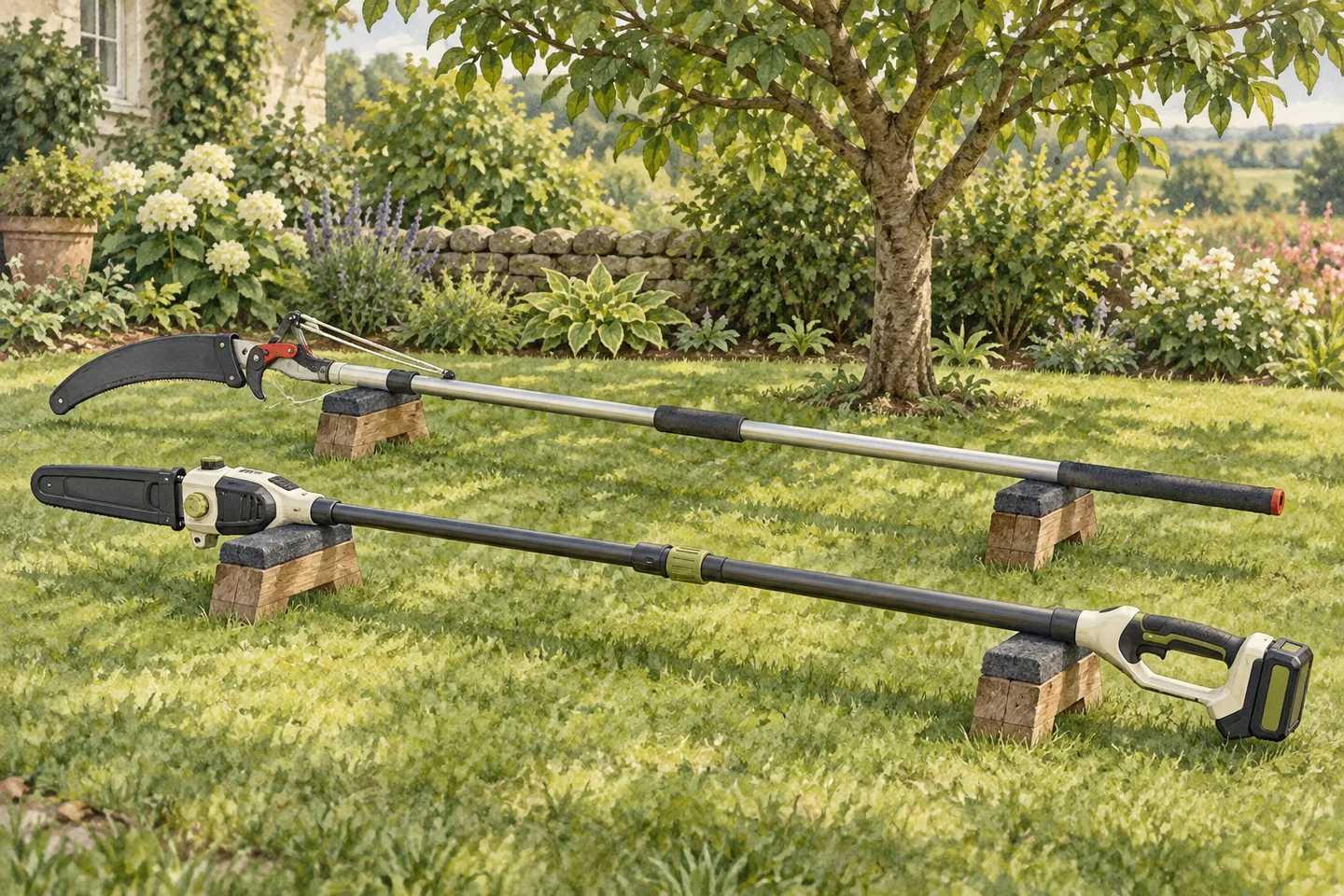
AI-generated illustration: manual and powered pole saws offer different approaches to pruning.
A pole saw is easy to buy for the wrong reason. You see a branch you cannot reach, find a tool advertising fifteen feet of reach, and assume the problem is solved. But reaching the branch is only one part of the job. You also need control of the tool and a clear place for the branch to fall.
The better purchase starts with the small pruning jobs you expect to repeat. One damaged limb over the roof is a reason to get the tree assessed, not a reason to buy a longer pole.
The Short Answer
For a few suitable branches each year, compare a manual pole saw first. It avoids batteries, a motor and chain lubrication, although you supply the cutting effort. For repeated pruning, a cordless pole saw can be worth the extra weight and maintenance. Existing compatible batteries can make the choice easier.
Two documented cordless options are the DEWALT DCPS620M1 and EGO PS1001. Choose between them by the battery system, complete tool configuration and reach you can actually manage. Neither is a recommendation for damaged trees, large limbs over structures or work near utility lines.
Three options and what each asks of you
| Option | Why I would consider it | What could rule it out |
|---|---|---|
| Manual pole saw | A small number of routine cuts; no charging or chain-oil routine | The required cutting effort or extended tool is difficult to control |
| DEWALT DCPS620M1 | A cordless kit worth comparing for an owner of compatible DEWALT batteries | You are buying into a new system for a rarely used tool |
| EGO PS1001 | A telescoping cordless option for an existing EGO yard-tool setup | Its complete weight, price or extended balance does not suit you |
DEWALT specifies an eight-inch bar and a shaft extending to ten feet, advertising up to fifteen feet of total reach. Those last two numbers are different measurements. DEWALT DCPS620M1 details.
EGO specifies a ten-inch bar, telescopic carbon-fiber shaft and up to thirteen feet of total reach for the PS1001. Its longer advertised configuration uses an additional extension. Do not compare the extended configuration’s reach with a kit price that excludes that part. EGO PS1001 details.
These are specification-based examples, not results from a side-by-side test. A larger bar or greater advertised reach does not establish which will be more comfortable in your hands.
Tool length is not the same as working reach
A reach claim can include the person holding the tool. It should not be read as the length of pole that arrives in the box. The angle at which the tool is used also affects the height you can reach from an appropriate position.
Before ordering, separate three measurements: the assembled tool length, the maker’s advertised total reach, and the collapsed or disassembled storage length. Then check whether an extension is included. That small exercise can prevent both an unsuitable purchase and a surprise when the tool will not fit where you intended to store it.
Do not try to make a short tool reach farther by using a ladder. A manual saw also creates a falling-branch hazard; removing the motor does not remove the need for a suitable job and position.
Weight at the far end matters
Two tools with similar total weights can feel quite different when extended. A powered cutting head places mass away from your hands. A large battery adds weight at the other end. The resulting balance matters more than how light the shaft material sounds in an advertisement.
If a retailer allows it, handle the assembled tool with the battery you would actually use, powered off and with its cover fitted. Ask to compare the working configuration rather than lifting only an empty display shaft. If controlling it already feels awkward, buying more reach is unlikely to solve that.
For a manual saw, check the locking arrangement, replacement-blade availability and how much pole you need to use for the recurring job. A simple tool is still a poor fit if you cannot manage it comfortably.
Price the parts you will actually need
A bare tool can be good value when a suitable battery and charger are already available. A kit can be better when the extra battery has another regular use. Add the cost of any required extension, replacement blade or chain, appropriate protective equipment, and storage supplies before comparing offers.
Powered pole saws need cutting-system maintenance. Check how the manual handles oil, tension, sharpening and replacement parts. Manual saws need their own blade and pole inspections. A small number of cuts per year may favor the simpler maintenance routine even when a motor would cut faster.
For either type, follow the exact manual’s protective-equipment, clearance and operating requirements. Keep a clear fall area and stay away from utility lines. If the branch is damaged, heavy, under tension or over something you cannot afford to hit, use a qualified tree professional. The CDC explains why even small tensioned limbs can be dangerous in its chainsaw safety guidance.
What I would choose for three different jobs
For a few small, routine pruning jobs, I would start with a manageable manual pole saw and compare the effort with hiring the work out. For repeated suitable pruning and an existing DEWALT setup, I would investigate the DCPS620M1 or its matching bare tool. With an existing EGO setup, I would compare the PS1001 configuration first.
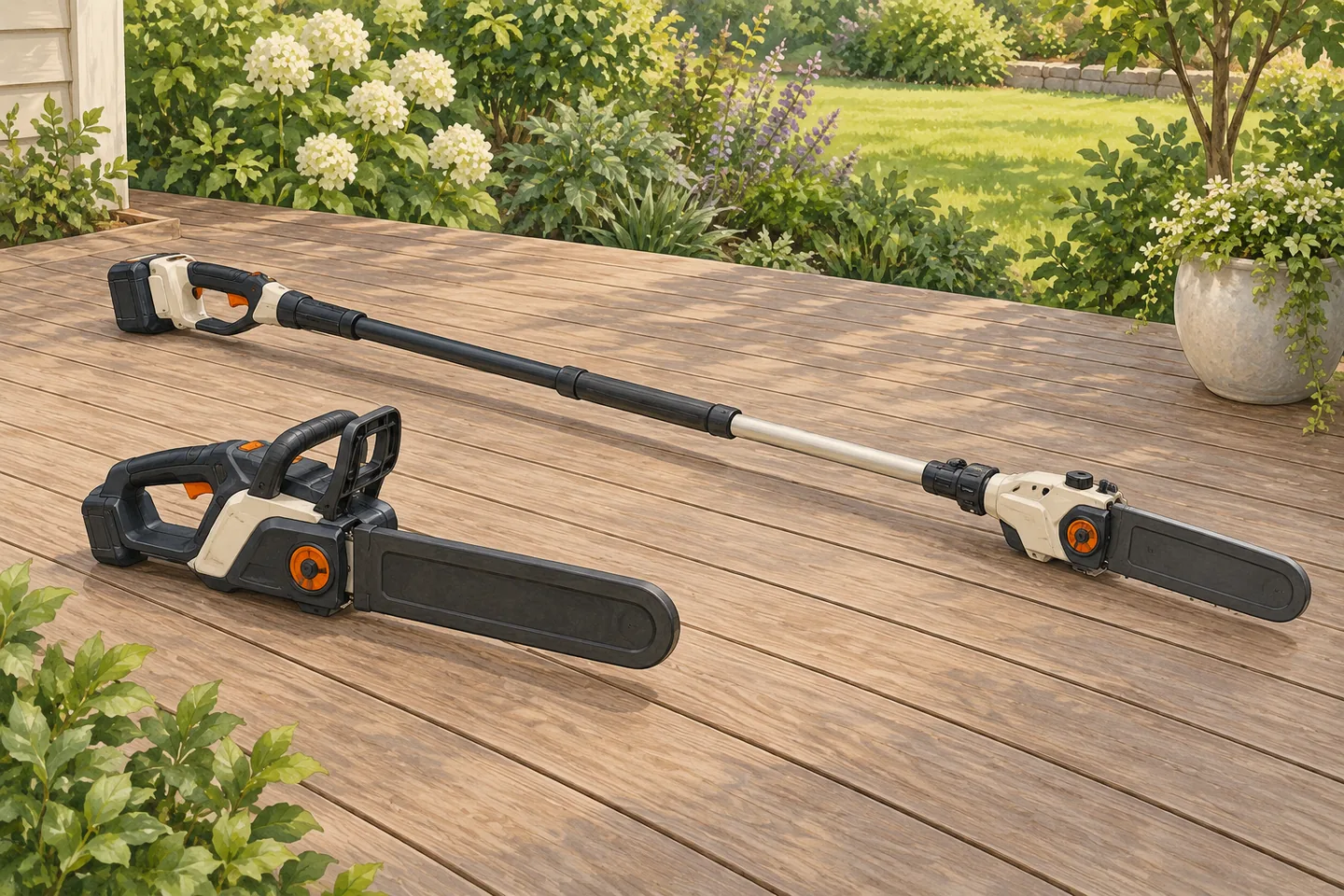
For wood already on the ground, start with our chainsaw versus pole saw comparison. For a difficult tree problem, the next purchase may be professional help. Buying a tool should follow that decision, not make it for you.
Research checked September 7, 2026. This is a researched buying guide, not our own hands-on test.
Related guides
comparison · Chainsaws and pole saws