Comparison · String trimmers
String Trimmer vs. Edger: When Is a Second Tool Worth Buying?
Compare trimming grass, maintaining a sidewalk edge, and reclaiming overgrown pavement before buying a dedicated edger or attachment.
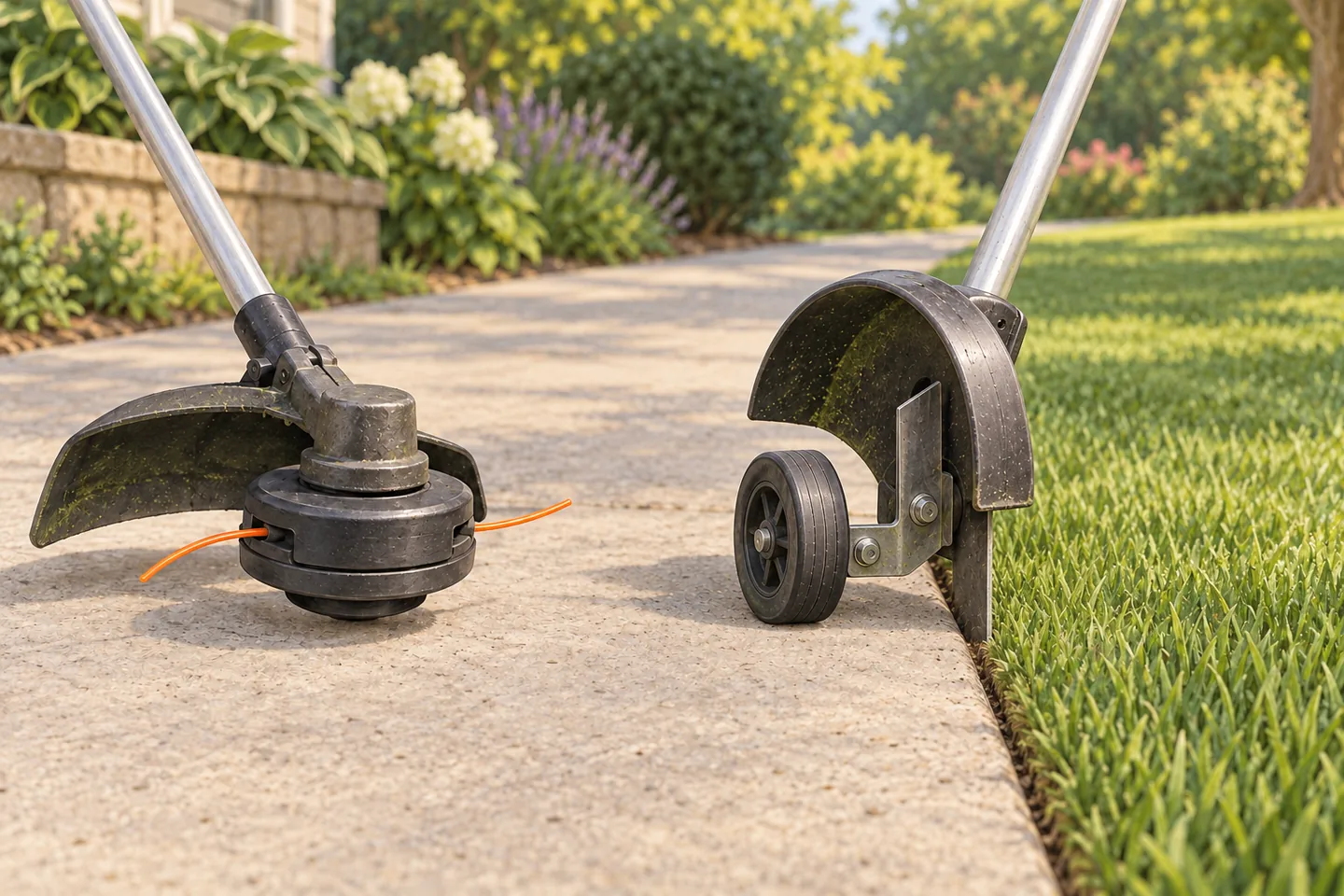
AI-generated illustration: a string head trims grass, while a blade edger defines the lawn boundary.
You finish mowing, but grass still hangs over the sidewalk and stands around the fence posts. Both jobs need attention. They don’t necessarily need the same cutting tool.
A string trimmer handles the places your mower can’t reach. An edger gives you a defined boundary between lawn and pavement. Whether you need both depends on what that boundary looks like now and how you want to maintain it.
The Short Answer
Buy a string trimmer first if your main job is cutting grass around fences, beds, and other obstacles. For a short, established sidewalk edge, a trimmer approved for edging may also give you the finish you want.
Consider a dedicated edger when you have long paved boundaries, want a consistent cut along them, or repeatedly struggle with turf spreading over the pavement. For a small amount of occasional edging, compare a manual edging tool before adding another powered machine.
The useful distinction is maintaining a line that already exists versus cutting that line back into overgrowth. Don’t buy two powered tools until you know which job you’re trying to solve.
What each tool actually does
| Job | String trimmer | Lawn edger |
|---|---|---|
| Grass a mower misses around obstacles | Its main job | Usually the wrong tool |
| Light growth along an established pavement edge | Can be suitable when the model allows edging | Can maintain a defined boundary |
| Turf spreading across a sidewalk | Can cut foliage, but removing the rooted overhang is a separate task | A blade edger may help establish the boundary; debris still needs collecting |
| Long, visible driveway border | Result depends on control and technique | Guide-wheel models support a repeatable route |
| Irregular planting-bed shape | Useful for nearby grass; protect plants and bark | Check the tool’s intended use rather than assuming every edger suits a bed |
A string head cuts with flexible line. A blade edger uses a different cutting arrangement. EGO’s documented Multi-Head system, for example, pairs a nylon-line trimmer attachment with a separate blade-edger attachment and guide wheel. They are different attachments because they do different work. EGO system details
Some tools marketed as trimmer-edgers still use line in their edging position. Read what the cutting head actually does; the word “edger” on a box doesn’t always mean a steel-blade machine.
If the edge is already in good shape
Start with the equipment you own.
Suppose your front walk has a clear lawn boundary and only a little grass leaning across it. If your trimmer supports edging and you can maintain that line comfortably, a second tool might not change much about your weekend.
Judge the result after clearing the clippings. Is the edge tidy enough for you? Does the job take a reasonable amount of time? Are you repeatedly correcting the same uneven patches?
You don’t need a sharply cut border to have a well-kept yard. Buy for the result you want, not somebody else’s photograph.
For model-appropriate setup and protective equipment, follow your manual. STIHL’s lawn-edging guidance is a useful starting reference; it includes guide-wheel positioning for an edger. It doesn’t replace instructions for a different tool.
If grass has swallowed part of the sidewalk
Cutting the grass shorter won’t necessarily expose the original pavement edge. You may still have rooted turf and soil to remove.
I’d separate that initial restoration from the routine maintenance afterward. A one-time cleanup can justify borrowing or renting suitable equipment, or paying for the edge to be restored, without committing you to owning another machine indefinitely.
Before any cutting, identify the actual pavement boundary and check for irrigation components, lighting wires, stones, and other obstructions. Use the tool only within its documented purpose and setup. A deeper cut isn’t automatically a better edge.
After the boundary is restored, reassess. If maintaining it with the trimmer is straightforward, the larger initial job hasn’t proved you need a powered edger every week.
When a dedicated edger earns its space
A long driveway with lawn on both sides is a different purchase from a short path to the front door.
I’d consider an edger if the edge is an important part of the finished lawn and doing it with the trimmer is consistently awkward. But I’d compare the whole job: fetching the tool, setting it up, edging, collecting debris, and putting everything away.
Here’s a hypothetical example. If another tool saves eight minutes per session and you use it 20 times in a season, that’s 160 minutes saved. Setup and cleanup can reduce that saving. Those numbers aren’t test results; they’re a way to ask whether the purchase changes your routine enough to matter.
If your frustration is actually a long fence line or lots of obstacles, an edger won’t solve it. Our large-yard string-trimmer guide focuses on that problem.
An attachment can make sense—but check the whole purchase
You may not need two complete powered tools. A compatible powerhead can accept separate trimming and edging attachments.
As a current example, EGO documents its EA0820 as an eight-inch edger attachment within its Multi-Head system. Check the listed compatible powerheads before buying. An attachment doesn’t become compatible just because you own a battery from the same brand. EGO EA0820 details
Compare the attachment, any required powerhead, battery, charger, and storage together. Also consider whether you mind swapping attachments during a session.
Check kit numbers carefully. EGO’s older MHC1502 combo page remains online but marks that configuration discontinued. A product page describing both attachments is useful documentation; it isn’t proof that the pictured kit is a current purchase option.
What I’d buy
For a small yard, I’d start with a manageable trimmer and see whether its approved edging setup meets my needs. For occasional restoration, I’d compare a manual tool or one-time help. For long boundaries I want to keep sharply defined, I’d price a dedicated edger or a compatible attachment.
The second tool should solve a recurring problem. If the edge already looks how you want and maintaining it isn’t a chore, keep the space in your shed.
Research checked September 5, 2026. This is a researched tool-choice guide, not a hands-on comparison. The time example is hypothetical.
Related guides
guide · String trimmers